

Brand positioning is the strategic decision about who an offer should be relevant to, within what category, and why it should be considered over its alternatives. It is formulated as a hypothesis and validated with evidence. It is not about choosing a slogan or repeating that a company is "the best"; it guides product, message, experience, and business priorities.
What is brand positioning?
A company competes to be considered in a specific situation. A person can compare direct brands, solve the task on their own, or postpone it. Positioning establishes the framework within which you want them to understand the offering and the difference that deserves attention. American Marketing Association It describes it in relation to an organization's position vis-à-vis its competitors and the communication of value to an audience.
The company decides what positioning it will attempt to establish; the market reveals whether that decision is credible and relevant. Therefore, an internal document alone does not prove a positioning strategy. Supporting signals must appear in the offering, the customer experience, and how potential buyers explain their choices. If they don't recall the difference or don't consider it important, the hypothesis needs further investigation.
This concept should not be confused with SEO positioning. SEO aims to improve the visibility and usefulness of pages in response to search intent. A brand strategy can guide what to communicate on those pages, but it doesn't guarantee rankings. Similarly, achieving a top organic ranking for a query doesn't demonstrate that the audience understands the competitive offering.
Positioning, branding and identity: how they connect
| Area | Central decision | Example of result |
|---|---|---|
| Positioning | What alternative to be for whom, in what context and with what difference. | Competitive hypothesis and criteria for testing it. |
| Branding | How to build and manage a brand over time. | Coordinated priorities of strategy and experience. |
| Identity | How to express and make that brand recognizable. | Language, visual system, and rules of behavior. |
| Bell | What message to distribute for a given objective and time period. | Ads, content, landing page, and measurement. |
A positioning of “guiding you through a complex first purchase” can lead to detailed instructions, unambiguous language, and support during the selection process. It doesn't automatically determine a color or font. brand identity It translates strategic decisions into consistent signals; an attractive identity does not make a promise true that the offer cannot sustain.
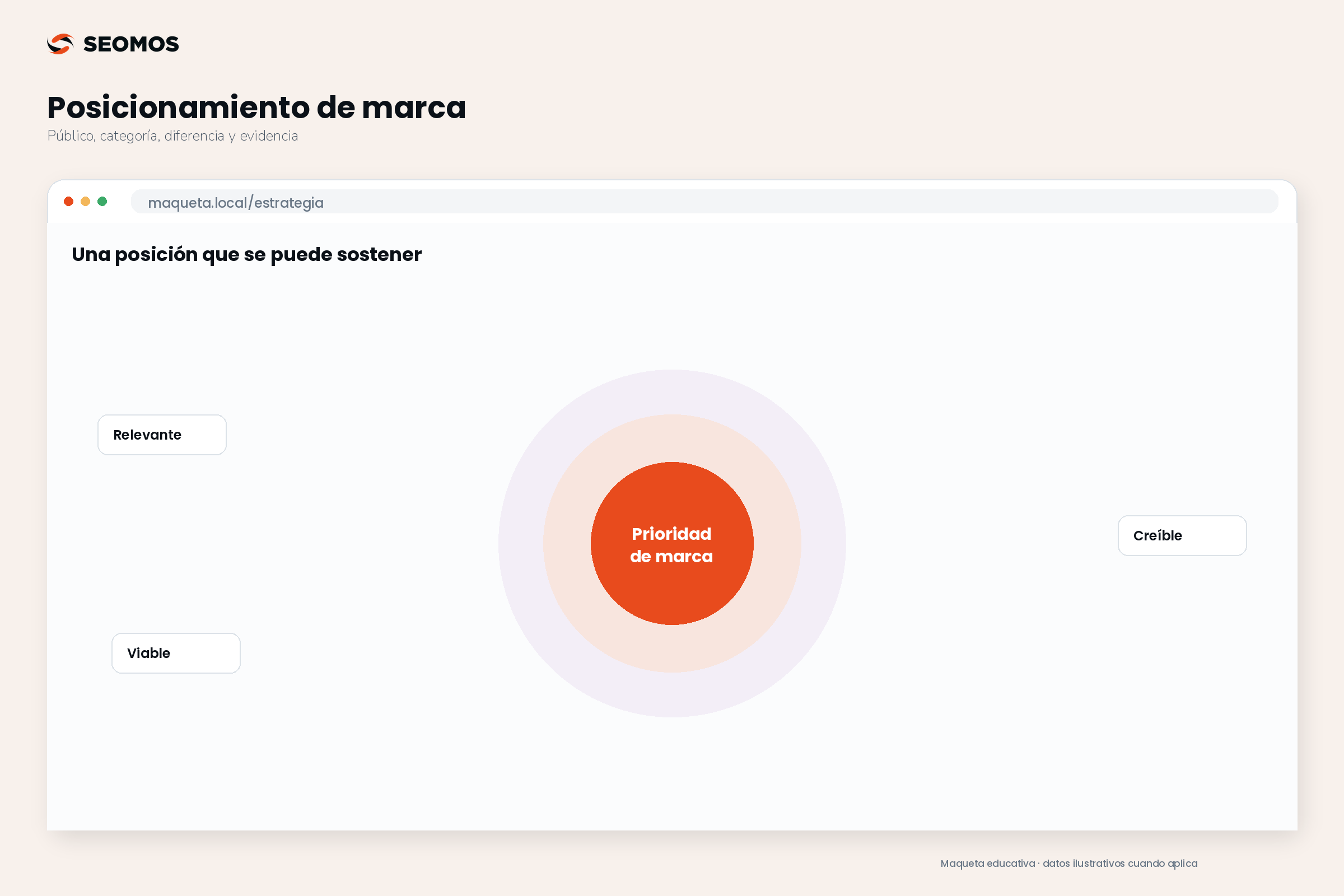
The four elements of a defensible position
1. Audience and situation
Avoid broad categories like “companies that want to grow.” Describe who makes the decision, what they are trying to achieve, and what condition changes their priorities. A purchasing manager who needs to replenish recurring inventory values different things than a founder testing their first product line. The same person can belong to different categories depending on the situation.
Investigate real or potential individuals, in addition to reviewing existing data. The service investigation guide of GOV.UK It is recommended to study what they are trying to do, how they are currently doing it, what problems they are encountering, and what they need to achieve it. Internal opinions serve as hypotheses, not as market confirmation.
2. Category and alternatives
The category allows someone to understand what the offer is and what it's comparable to. It can be a well-known category, a specialty within it, or a combination that requires explanation. Inventing a new label can generate curiosity, but also require effort to understand. The minimum requirement is that the public knows when to look for it and what to expect.
It includes indirect alternatives. To organize contacts, a company can compare a CRM, a spreadsheet, a custom-developed system, or maintain its current process. If the analysis only considers products with identical labels, it may overlook the option that actually wins the decision. It defines what would have to happen for someone to change their behavior.
3. Relevant difference
A difference must matter in the buying situation and be difficult to reduce to a single phrase that anyone can claim. “Quality,” “innovation,” and “personalized service” need to be specified. The difference can come from the model, specialization, process, experience, or a combination; it doesn't have to be a novel feature if it better addresses a proven priority.
4. Evidence and limits
Link the promise to available evidence: documented scope, demonstrations, policies, verifiable data, capabilities, or representative samples. Don't invent clients, figures, or certifications. State conditions that will change the outcome. A more focused and demonstrable promise is often more useful than a grandiose claim that the team can't explain.
How to create a positioning strategy step by step
Step 1: Define the decision you want to influence
Specify the event: choosing a solution, requesting an evaluation, changing providers, or adding a second option. Record who decides, who uses it, and who can block it. Don't try to address all audiences in a single sentence. If there are clearly distinct decisions, it may be necessary to prioritize one or formulate proposals for each segment under the same brand.
Step 2: Gather language and evidence
Combine interviews, sales inquiries, internal searches, analytics, and reasons for loss. Ask about recent events: what triggered the search, what alternatives the person reviewed, and why they discarded some. Responses about a specific purchase tend to be more actionable than a general request for ideas. Separate observed patterns, authoritative quotes, and team interpretations.
Step 3: Map alternatives with useful criteria
Create a table before drawing a map. In the rows, list real alternatives; in the columns, the buyer's criteria, evidence, and conditions. A two-axis map forces simplification: use it to discuss a specific relationship, not as a total representation of the market. Price and quality are rarely sufficient axes if no one has defined how to measure "quality.".
Step 4: Formulate an internal hypothesis
Use this structure as a tool, not as advertising copy: “For [audience in a situation], [brand] is [category] that helps [relevant outcome] through [difference], supported by [evidence].” Add exclusions and assumptions. If the sentence doesn't change any product, content, or sales decisions, it's probably still generic.
Step 5: Test comprehension, relevance, and credibility
Present comparable prototypes to people in the target segment and ask them to explain what they think each option offers, who they would choose it for, and why. Don't just ask which one they like. Strategyzer suggests the Value Proposition Canvas as a way to relate the customer profile to the value map and prepare hypotheses to validate them; the canvas organizes the conversation, but does not replace talking to the market.
Step 6: Translate the decision into touchpoints
Review your product, service names, homepage, proposals, ads, and customer service. Define which message should appear first, what evidence supports it, and which phrases should be removed. landing page It is useful for testing a message in a specific campaign, as long as a single conversion is not interpreted as total validation of the strategy.
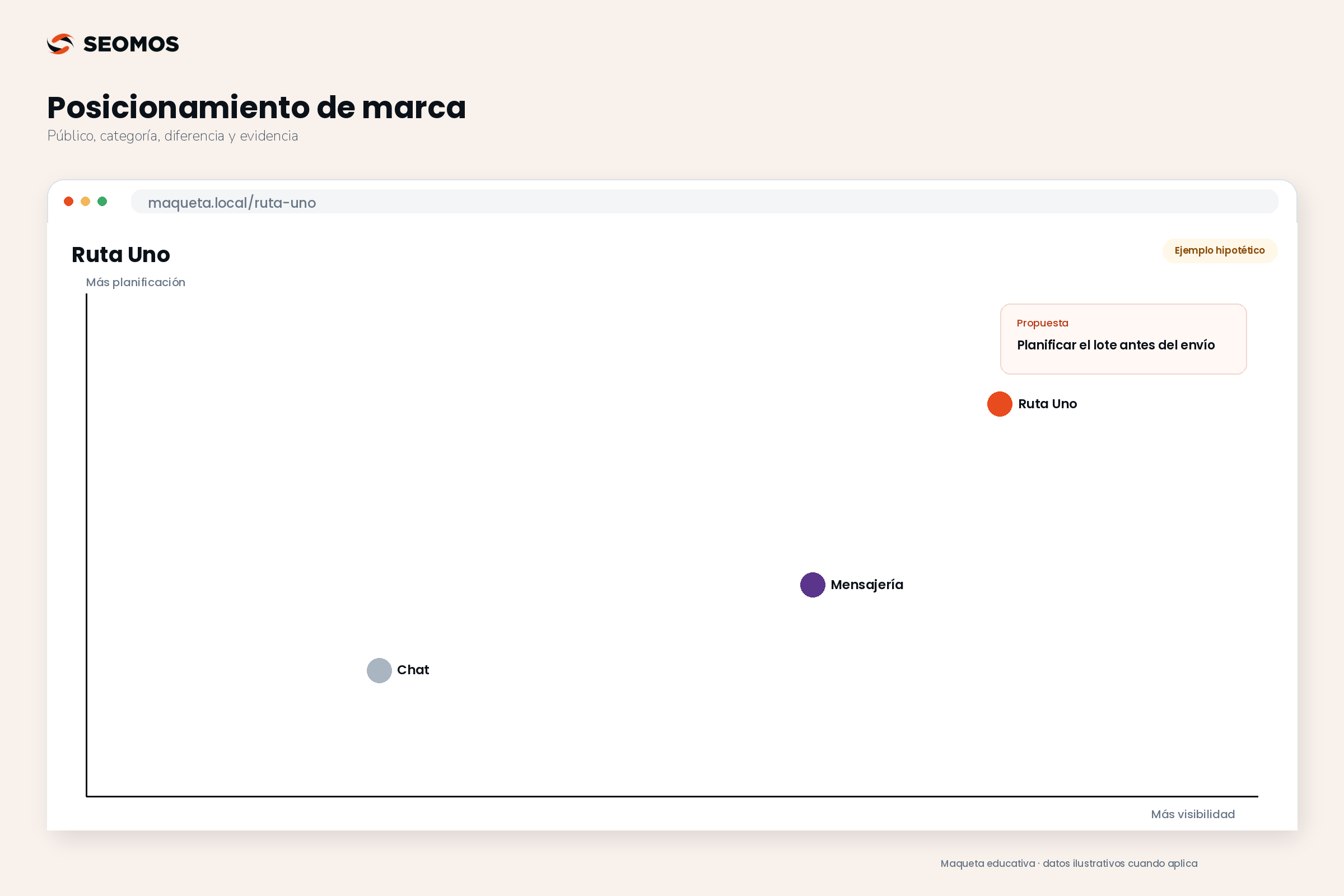
How to create a positioning map without deceiving yourself
A perceptual map positions options along two dimensions. It can reveal a pattern and raise questions, but this depends on who is evaluating, how the variables are formulated, and what alternatives are included. A map drawn by the team represents their opinion; to call it market perception, you need to collect data from relevant people using a documented method.
- Define a situation and a segment, not "the market" in the abstract.
- Select alternatives that the public considers, including indirect ones.
- Formulate understandable dimensions and avoid two ways of measuring the same thing.
- Explain the source, sample, and date of the information.
- Interpret free spaces as questions, not as guaranteed demand.
Don't necessarily aim for the extreme end of each axis. A desirable position should be relevant, viable, and defensible. An empty space might indicate that no one wants it, that it costs too much to address, or that the category is not yet understood. Validate the need and operational capacity before declaring an opportunity.
Developed example of brand positioning
Hypothetical example: Ruta Uno is a fictional platform that coordinates local deliveries for small stores. The initial category, “innovative logistics solution,” doesn't reveal what problem it solves. Exploratory interviews show two scenarios: scheduled deliveries of multiple orders and individual emergencies. The platform handles the former well, but lacks the operational capacity to compete in terms of immediacy.
The team prioritizes stores that consolidate daily orders and need to confirm routes before a deadline. Alternatives include coordinating couriers via chat, hiring vehicles by the day, or using other platforms. The proposed difference isn't "being faster," but rather offering an advance view of capacity, cost, and status for the scheduled batch. Evidence of this must come from the platform's actual features and conditions.
| Element | Decision | What remains to be checked |
|---|---|---|
| Public | Stores that group local orders every day. | Frequency and volume in probable segments. |
| Category | Digital coordination of scheduled deliveries. | If the expression is understood without extensive explanation. |
| Difference | Plan the batch before confirming shipments. | Relevance versus price and coverage. |
| Evidence | Functional view with visible conditions and states. | If people complete the task and trust the data. |
The page avoids messages about “instant delivery” that would create a need the service doesn't fulfill. The team tests two ways of explaining the category, observes what participants understand, and records objections. Then they review relevant inquiries and planning usage. No single piece of data proves success; together they allow them to refine the hypothesis.
Differentiation and distinctiveness are not the same thing
Differentiation explains why an offer should be considered in a given situation. Distinctiveness makes it easier to identify which brand a signal originates from. A specialized process can be a differentiator; a learned visual combination can be a distinctive asset. The former helps to evaluate the proposition, and the latter reduces confusion about authorship.
He Ehrenberg-Bass Institute It assesses distinctive assets based on recognition and exclusive association. This explains why choosing a different color at a meeting doesn't automatically link it to the brand. Building that association requires consistent use and verification; it also doesn't make the business proposition unique.
It's important to address both questions. Does the person understand a relevant reason to consider the offer? Can they recognize who is offering it? Communication that is easy to identify but irrelevant doesn't position well. A valuable difference expressed generically can end up being attributed to another company. The strategy defines the priority and the identity help to encode it.
How to measure and validate positioning
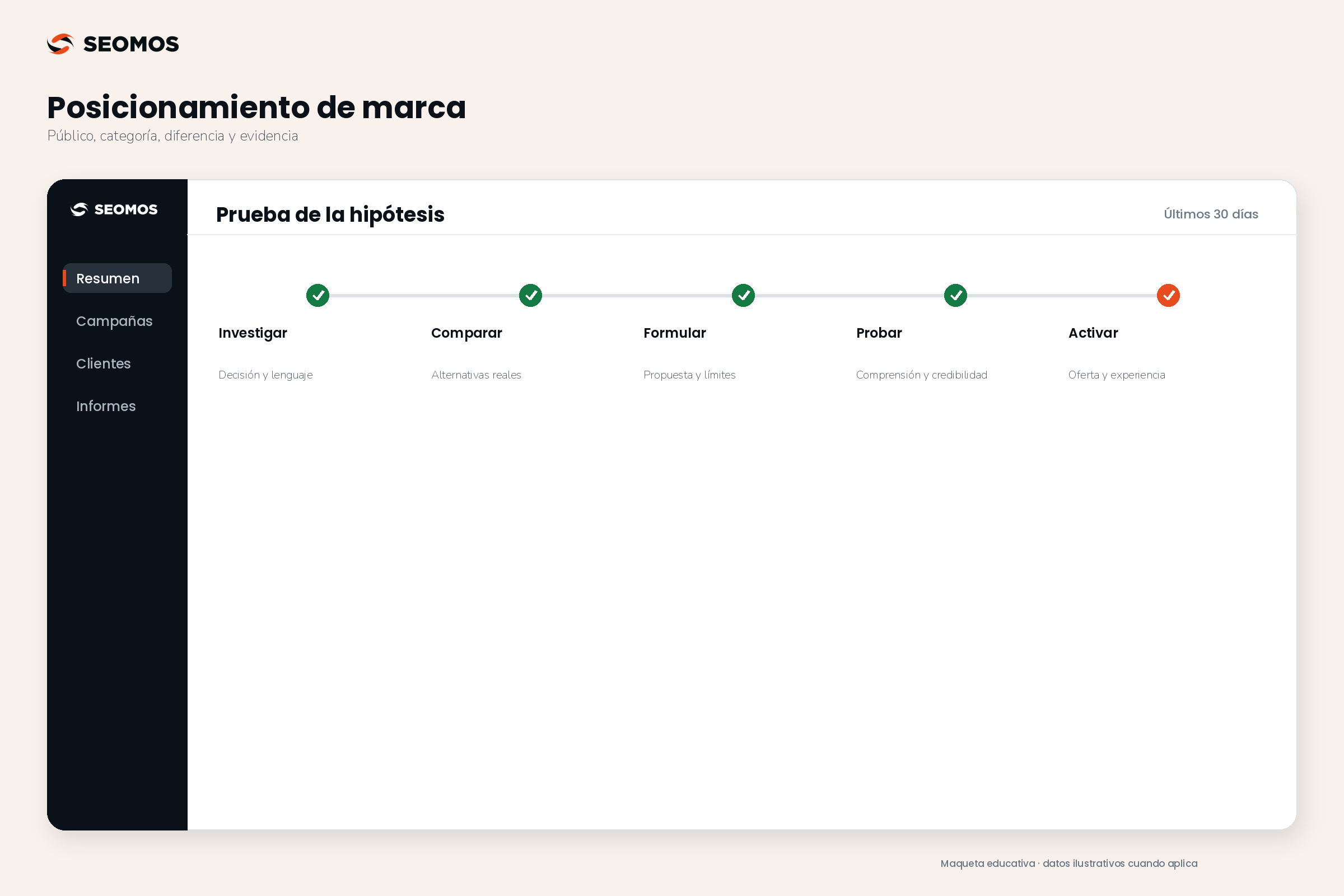
Begin by examining the mental sequence the strategy aims to influence: understanding, relevance, credibility, and consideration. Design questions or tasks that explore each stage. If someone understands the promise but doesn't consider it important, the problem differs from a relevant offer that seems impossible to deliver.
- Comprehension: How the person explains the category and the offer in their own words.
- Association: what attributes she spontaneously links when asked.
- Credibility: what evidence it accepts and what objections it maintains.
- Consideration: In what situations would you include the brand among your options?.
- Behavior: relevant consultations, tests and purchases under comparable conditions.
Record the methodology: audience, question, order, date, and sample size. A follower survey does not automatically represent buyers in the segment; unearned leads also provide information. Compare periods where there is a benchmark and note parallel changes in product, price, promotion, and distribution before attributing a movement to positioning.
Common mistakes and when to reconsider your strategy
Avoid choosing attributes simply because they sound good, confusing a slogan with strategy, representing competitors without data, and claiming superiority without defining the measure. Another mistake is accumulating incompatible benefits to avoid excluding any audience. Positioning requires priorities: it doesn't force you to exclude everything else, but it does determine which idea guides your proposition.
Review your strategy when the offering changes, the audience compares different alternatives, or evidence contradicts core assumptions. Also review it when the message consistently attracts opportunities the business can't handle. Don't change your strategy for every underperforming campaign; first review distribution, creative, experience, and measurement. Repositioning has learning costs and can weaken valuable partnerships.
To bring a hypothesis to your site, start with content that answers the visitor's intent and verifiable evidence. Research on keywords It helps to observe how certain needs are expressed, without turning search volume into sufficient proof of ranking. If you need to review the relationship between value proposition, experience, and digital communication, consider a diagnostic conversation with SEOMOS with a defined scope.
Frequently asked questions about brand positioning
What is a brand positioning strategy?
It's a hypothesis about the target audience and situation a brand prioritizes, the category in which it competes, the relevant differentiator it offers, and the evidence that supports it. It guides product, experience, and communication decisions. It must be tested, because simply stating it internally doesn't make it market perception.
How do you write a positioning statement?
Identify your target audience and context, category, relevant outcome, differentiator, and proof. Draft it first as an internal tool and add boundaries. It doesn't have to sound like an advertisement. Then, ensure it allows you to prioritize and that people in your target segment understand and find the proposition credible.
Is positioning the same as a slogan?
No. Positioning is a strategic decision involving a target audience, alternatives, and evidence. A slogan is a verbal piece that can express part of that decision. A memorable slogan doesn't fix an irrelevant offering, and a clear strategy can be communicated with different messages depending on the channel.
What types of positioning exist?
An offering can prioritize specialization, process, experience, occasion, access, or other differentiators. These labels help explore options, but don't choose one simply to fill out a matrix. The useful question is what an audience needs in a given situation, and what actual capacity allows you to respond credibly.
How can you tell if a positioning strategy is working?
Evaluate whether the audience understands the offering, considers the difference relevant, believes the evidence, and includes the brand in anticipated situations. Combine qualitative research and behavioral analysis under comparable conditions. Define a baseline and avoid attributing all business change to a single intervention.
When should the positioning be changed?
When the offering, needs, alternatives, or the ability to demonstrate differentiation change substantially. Also, when repeated evidence contradicts the hypothesis. Before repositioning, rule out execution or measurement problems and assess which useful associations should be retained.
Sources consulted
Editorial consultation: 31-08-2026. The process, tables and Route One are original work; the case is hypothetical and does not represent a client or SEOMOS results.