

A lead magnet is a useful resource that a company offers in exchange for contact information and, where appropriate, clear authorization for future communications. Its quality isn't measured by the number of downloads: it must solve a specific need, attract the right audience, and create a natural transition to the next step. A short, actionable template can generate better opportunities than a long, generic ebook.
Many companies create a guide, add a form, and call everyone who downloads it a "lead." Then they discover their database is growing, but the sales team doesn't know what to do with those registrations. The problem isn't always the resource itself: it could be an overly broad promise, a form that lacks context, a poorly segmented distribution, or a disconnected follow-up sequence.
This guide explains what a lead magnet is, how to choose the format, design the exchange, distribute it, and measure the quality of the leads. It also addresses a point that shouldn't be treated as fine print: authorization to use personal data in marketing activities.
What is a lead magnet and what is it used for?
A lead magnet is a piece of content, tool, or experience with controlled access that delivers immediate value in exchange for user information. Common formats include templates, calculators, checklists, samples, lessons, diagnostics, comparison tools, and reports. The exchange may request an email address, phone number, or other relevant data.
Its function is not to "buy" an email with an attachment. It should help a person move forward with a task related to a problem the company knows how to solve. If an agency offers a template for prioritizing SEO findings, for example, the resource should allow users to evaluate those findings and not just describe what SEO is.
The lead magnet also functions as a signal. The choice of the resource reveals a need or a stage in the decision-making process. This signal is only useful if it's recorded with context: page, campaign, version of the resource, date, and voluntary responses. An isolated download doesn't demonstrate purchase intent.
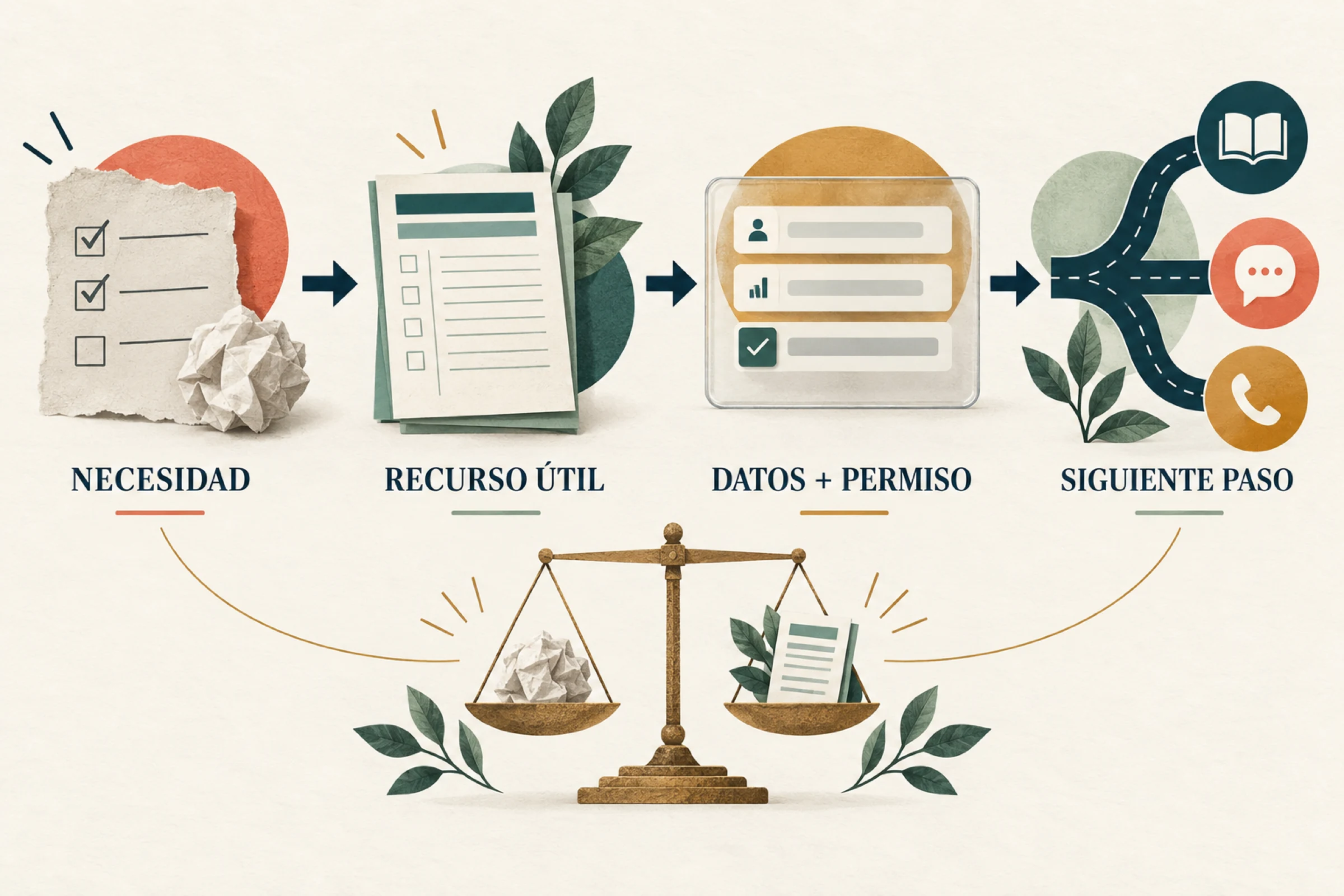
Lead magnet, open content and commercial offer
Open content allows learning without giving away personal information. This is important for searchability, trust, and accessibility. A lead magnet adds a useful element that can justify the exchange: an editable file, a personalized assessment, exclusive data, or a work-saving tool. Locking a basic explanation that already exists on many pages behind a form often creates unnecessary friction.
The sales offer aims to trigger a purchase, quote request, or conversation. A lead magnet can facilitate that action, but it shouldn't disguise a sales call as an educational resource. The page should clearly state what is being received, in what format, who is delivering it, and what will happen to the data.
It's also important to distinguish it from a promotional incentive. A discount attracts someone already considering a purchase; a template might attract someone just starting to structure their problem. Both generate leads, but they represent different moments and intentions. Combining them into a single metric makes it difficult to interpret quality.
How to choose a lead magnet idea
Start with a specific task for your audience, not the latest trend. Review business questions, internal searches, support conversations, objections, and common roadblocks. HubSpot Academy suggests researching your audience's problems, creating an actionable resource, and distributing it strategically. This approach avoids producing content first and then trying to find potential users.
A good idea meets five conditions:
- It is specific: It solves a specific task; it doesn't promise to transform an entire business.
- It is relevant: It attracts people who could benefit from the company's experience, product, or service.
- It is used quickly: Courage does not depend on reading a hundred pages before acting.
- Demonstrate good judgment: It incorporates decisions, examples, or structure that are not obtained by copying a generic list.
- Connect to the next step: Continuity expands the result without turning the resource into an advertisement.
To evaluate an idea, write a sentence: “It helps [audience] to [task] when [situation] by means of [tangible result].” If the audience or task is unclear, the proposal is not yet focused enough.
Lead magnet formats and when to use them
| Format | Useful when | Frequent risk |
|---|---|---|
| Checklist | The task has verifiable steps. | Create an obvious list without criteria. |
| Template | The user needs to produce or record something. | Submit a file that is difficult to edit. |
| Calculator | A decision depends on variables and assumptions. | Hiding the formula or presenting false accuracy. |
| Report | There is original data or a specialized synthesis. | Publishing figures without method or date. |
| Class or webinar | Learning requires demonstration and questions. | To lengthen a promotional presentation. |
| Diagnosis | The result can be customized with relevant data. | Promising an audit that is actually a sales form. |
| Sample or proof | The product experience is part of the value. | Demanding too much data before testing. |
An editable template is often more useful than a PDF when the goal is planning or calculation. A PDF works well for a visual guide, protocol, or reference report. If the resource needs to be kept up-to-date, a webpage or tool can prevent older versions from circulating.
Interactive resources require more development and maintenance. Before building a complex calculator, test its usability with a simple spreadsheet or a user-friendly version. Technical sophistication doesn't compensate for an irrelevant question.
How to create a high-quality lead magnet
1. Define the result. Specify what the user will be able to complete, decide, or avoid after using it. The promise on the page and the delivered content must match.
2. Gather your own evidence. Use processes, anonymized cases, real-world questions, and technical criteria. Verify external sources and clarify assumptions. Don't turn a collection of definitions into a closed resource.
3. Design for use. Hierarchy, contrast, mobile readability, editable fields, instructions, and examples matter more than an ornate cover. Include version or date when the content may change.
4. Reduce the load. Eliminate lengthy introductions and repetitions. A two-page checklist can be comprehensive if it enables action. The length is justified by the task.
5. Add context and boundaries. A calculator should explain the formula; a financial or legal template should state its limitations; a report should show the date and method. Avoid results that appear to be definitive diagnoses without sufficient information.
6. Try the full route. Download on mobile and desktop, validate email, links, permissions, format, file size, accessibility, and subsequent response. Check what happens if the user already exists, enters invalid information, or requests to stop receiving messages.
7. Assign owner. Someone needs to review the validity, links, and conversions. An abandoned resource can continue to collect data and deliver outdated recommendations.
Landing page and form for the lead magnet
The landing page It should allow for quick decision-making. Include a title describing the outcome, a view of the resource, who it's for, what it contains, format, approximate usage time, and a form proportional to the exchange. Testimonials or figures should only be used when they can be verified.
Request the necessary data to deliver, segment, or follow up. For a general checklist, email and name may suffice. For a B2B calculator, business variables may be needed, but they shouldn't be reused for other purposes without adequate information and justification.
Confirmation can be done on the same page, via a thank-you page, or by email. Providing the resource immediately reduces uncertainty. The thank-you page can explain the next step, offer related content, or invite users to an optional conversation, without implying that the download is equivalent to requesting a call.
Track form errors and abandonment rates carefully. A low rate isn't always fixed by removing context or hiding conditions. It can indicate misdirected traffic, a weak promise, lack of trust, or too many fields.

Personal data, authorization and transparency
Submitting a resource and authorizing marketing communications are related but not identical decisions. Individuals must understand what information is being collected, who is using it, for what purpose, and how they can exercise their rights. A linked policy does not replace a clear explanation at the point of collection.
In Colombia, the Superintendency of Industry and Commerce has indicated the need for proof of prior, express, and informed consent to process personal data for advertising or marketing purposes, as well as the obligation to respect requests for deletion and suspension. Silence and pre-ticked boxes do not constitute consent. Implementation should be reviewed according to the type of data, relationship, and jurisdiction; this guide does not replace legal advice.
Authorization to release a file should not automatically be presented as unlimited permission for all channels. It should specify whether emails, messages, or calls will be used, offer affirmative action when required, and retain evidence. It should also facilitate revocation without obscuring it with unnecessary processes.
Privacy also improves data quality. A transparent promise reduces disposable records and false expectations. Avoid buying, sharing, or enriching databases without verifying purpose, origin, and rights. Consult the Privacy Policy applicable and keep form, CRM and submission platforms aligned.
How to distribute a lead magnet
The resource should appear where the need it addresses arises. A related article might include a contextual invitation; a paid campaign might direct users to a specific landing page; a sales conversation might share it as supporting material. Publishing it across all channels with the same message often ignores differences in intent.
In SEO, keep the content that answers the query visible and offer the resource as an additional tool. Hiding the main answer behind the form harms the user experience and limits the page's ability to demonstrate usefulness. The lead magnet should expand upon, apply, or personalize the explanation.
In advertising, align keywords, ads, landing pages, and resources. Exclude irrelevant audiences and document campaign parameters. On social media, showcase a real-world example: a page, a sample, or a usage case. The message "free download" doesn't explain why it's worth the attention.
Self-distribution includes newsletters, navigation, content, and commercial signatures. Collaborative distribution can include partners, events, or communities, provided the agreement does not involve opaque data use. Define who collects, who receives, and who communicates.
What happens after the download
The initial communication should deliver what was promised and be easy to use. A clear subject line, a working link, and brief instructions are usually sufficient. Avoid turning the delivery email into a string of unrelated offers.
The subsequent sequence can delve deeper into the same problem: an example, a common mistake, an invitation to respond, or supplementary content. The frequency and channel should correspond to what has been reported. marketing automation It serves to execute rules and remember actions; it does not guarantee relevance.
Define when a lead is passed on to the sales team. Downloading an educational resource doesn't always warrant a call. Combine signals such as resource type, stated profile, explicit request, subsequent interaction, and fit. Retain the possibility for the person to learn without immediately entering a sales pipeline.
In a CRM, it stores the resource's origin, version, authorization, and preference changes. A useful integration prevents duplicates and simplifies handling update or deletion requests. Learn how a solution like SEOMOS AI CRM It could fit into the flow before importing data.
How to measure performance and quality
The landing page conversion rate is calculated by dividing valid registrations by eligible visits. It's a measure of engagement on that page, not revenue. Segment by source, device, audience, and version to avoid mixing different experiences.
It combines measures of acquisition, use, quality and outcome:
- eligible visits and correct submission rate;
- cost per registration, when there is an attributable investment;
- deliveries, bounces, and access to the resource;
- percentage of records with verifiable consent;
- subsequent interactions related to the topic;
- qualified opportunities originated or assisted;
- time until the next useful action;
- cancellation requests, complaints and invalid data;
- associated revenues, with an explicit attribution rule.
“Quality” must be defined before comparing formats. It could mean a fit with a profile, a confirmed need, an accepted conversation, or a closed sale. If the team changes the definition during the campaign, keep all versions. Review How to choose KPIs to avoid turning every available figure into a primary indicator.
Don't automatically attribute a sale to the last form. A lead magnet can initiate, assist, or reactivate a relationship. Compare reasonable cohorts and windows, and distinguish correlation from causation. A resource with fewer downloads can be more valuable if it addresses needs that the company can fulfill.

Hypothetical example: SEO prioritization template
Hypothetical example. A consulting firm has published an editable template for prioritizing SEO issues. The target audience consists of website managers who already have identified issues but don't know how to prioritize them. The resource includes criteria for impact, effort, dependency, and risk; it also features a completed case study.
The landing page explains that the template does not replace an audit and requests the user's name and email address for delivery. The communication authorization form is clearly presented according to the intended use. The delivery email includes instructions and a link to an open guide on audits.
During the first month, campaign A receives 300 sign-ups and campaign B receives 90. If the team only considers volume, A appears superior. Upon segmentation, they discover that B generates more responses from active websites and addresses issues within the consultancy's scope. A attracts students who use the template for academic purposes. Both audiences can benefit, but they require different objectives and follow-up.
The company adjusts ad A, adds a preview, and changes an optional question. It doesn't add fields to block students; it improves the clarity of the promise. Then it compares a new cohort with the original definitions and documents the change.
Common mistakes that reduce value
Choose the format before the problem. An ebook isn't automatically more valuable than an editable document. It starts with how you use it.
Promising too much. “Double your sales” cannot be sustained with a checklist. Describe a concrete and verifiable result.
Repeat superficial content. If the resource does not incorporate a method, example, or additional utility, the form feels like a barrier.
Asking for data without explaining its use. Opacity reduces trust and can create compliance risks. Request relevant information and communicate it clearly.
Send all records to sales. The download indicates thematic interest, not consent for a conversation or qualified opportunity.
Measure only downloads. It adds delivery, usage, fit, progression, losses, and results, with stable definitions.
Forget about maintenance. Review links, figures, legislation, design, and compatibility. Remove or update resources that no longer reflect current practice.
Checklist before publishing
- The audience, task, and outcome are defined in one sentence.
- The preview matches the delivered content.
- The resource can be used in the intended format and device.
- The sources, dates, formulas, and limits are documented.
- The form only asks for relevant information.
- The treatment information and authorization are clear and verifiable.
- Delivery works for new registrations, existing registrations, and invalid addresses.
- The next step is relevant and does not presuppose a purchase intention.
- CRM and analytics save origin, version, and preferences without duplicating contacts.
- The metrics separate volume, usage, quality, and outcome.
- There is a person in charge and a review date.
Sources consulted
Document consultation: September 9, 2026. The format and measurement recommendations, as well as the example, are editorial suggestions for this guide. Data obligations should be assessed for each context with expert advice.
- HubSpot Academy: Creating a Targeted and Actionable Lead Magnet.
- HubSpot: definition, formats and process of a lead magnet.
- Superintendency of Industry and Commerce: authorization and deletion of data for marketing.
- Superintendency of Industry and Commerce: consent and pre-ticked boxes.
- Information Commissioner's Office: Direct Marketing and Privacy Guide.
Frequently asked questions about lead magnets
What is a lead magnet?
It's a useful resource offered in exchange for contact information and, where applicable, authorization to communicate. It could be a template, checklist, calculator, lesson, or diagnostic tool. It should address a specific task and explain what the person will receive and how their information will be used.
What is the best lead magnet format?
There is no single universal format. A checklist is useful for verifiable steps; a template, for producing something; a calculator, for exploring variables; and a lesson, for demonstrating a process. Choose the format after defining the task, the context, and the outcome.
How much data should the form ask for?
Only the information necessary to deliver the resource, manage consent, and perform informed segmentation. A simple resource may require few fields. If additional data is requested, explain its purpose and avoid turning the form into a disguised marketing tool.
Does downloading a resource turn someone into a sales opportunity?
Not necessarily. A download shows interest in a topic, but it could be due to learning, research, or curiosity. To create an opportunity, additional criteria are needed, such as fit, confirmed need, and acceptance of a conversation or next business step.
How do you measure the conversion rate of a lead magnet?
The landing page conversion rate divides valid leads by eligible visits. It should be complemented with metrics on delivery, usage, cost, consent, quality, opportunities, and outcomes. Segment by source and cohort, because a high conversion rate with irrelevant leads may have little commercial value.
Does a lead magnet have to be free?
It doesn't involve monetary payment, but there is an exchange of attention and data. Therefore, "free" doesn't eliminate the need for transparency. The individual must know the content, how their information will be used, and what communications they may receive.