

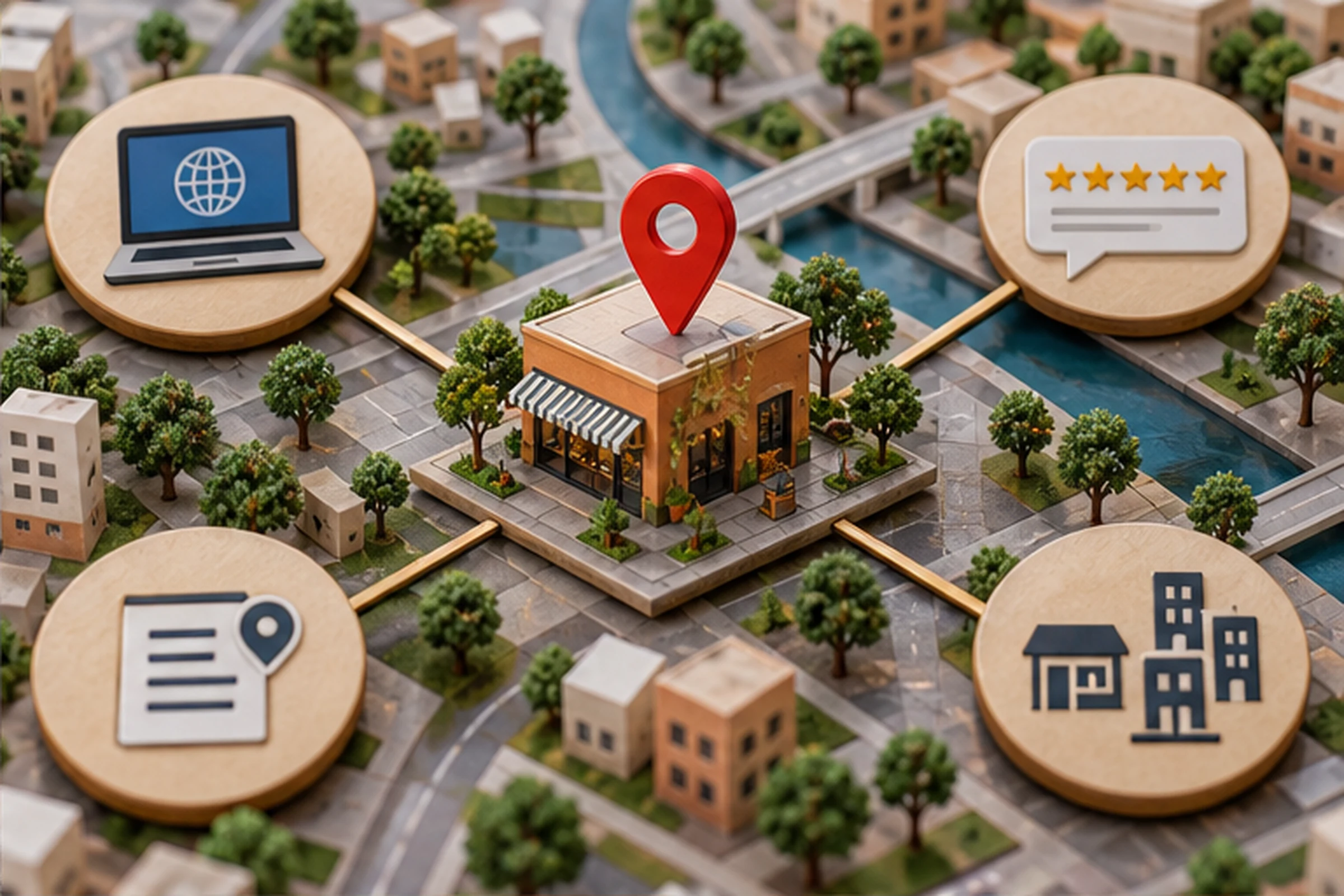
Local SEO improves the likelihood that a real business will appear when someone searches for a product or service in a specific area. It combines eligibility and management of the Business Profile, useful web pages, consistent data, reputation, and local authority. Google explains that results depend primarily on relevance, distance, and prominence; there is no pay-to-win option for better local organic ranking.
The strategy must reflect the existing operation. Creating virtual offices, duplicate profiles, or keyword-heavy names can lead to changes or suspensions. The first task is to confirm which business units, locations, and departments comply with current policies.
What is local SEO?
It's the optimization of your digital presence for searches with explicit or implicit geographic context: "dentist in Medellín," "coffee shop nearby," or "open workshop." It can involve map results, profiles, organic pages, directories, and other formats.
It's not limited to Google Maps. The site explains services and location, profiles provide immediate information, and mentions or reviews add context. Each platform maintains its own rules.
Relevance, distance, and prominence
Google describes relevance as the fit between profile and search; distance as the proximity between business and location used; prominence as how well-known the business seems, including web information, links, articles, and reviews.
You can't control the user's location or an exact formula. You can, however, accurately represent category, services, address, hours, and reputation. Avoid reducing each result to simply "add more keywords.".
Who is eligible for a Business Profile
According to the guidelines, a business can have a physical presence if it has a location that customers visit or travel to, under specific conditions. Businesses that are exclusively online do not become physical locations simply by renting an address. Virtual offices are not eligible.
A coworking space requires clear signage, customer service, and dedicated staff during declared hours. Service area businesses must set up and, where applicable, conceal their address. Review the current policy for regulated categories and special cases.

Name without keyword stuffing
The name must match the recognized brand on signage, website, and documents. Do not add city, phone number, promotion, or service list unless they are part of the actual name. Google warns that unnecessary information may result in suspension.
The details go in their respective fields: category, address, hours, services, and description. Consistency facilitates identification and reduces third-party edits.
Categories and services
Choose a primary category that completes “this company is…”, not “this company has…”. Google recommends a few specific and representative categories. Add secondary categories only if they describe important activities.
Services, products, and attributes expand context without distorting the name. Check availability by country and category. Maintain prices and conditions if you publish them.
Address and service area
Use your real and accurate location. A store with signage and staff can display your address. A professional working from home and visiting clients should hide their address and define their service area, according to company policies. The service area does not automatically create a ranking across all selected municipalities.
Avoid P.O. boxes and inactive addresses. For multiple locations, each needs its own staff, presence, and management. Don't duplicate profiles to cover different neighborhoods.
Complete operational information
Keep your regular and special hours, phone number, website, services, and current status up to date. Accuracy prevents missed trips and unnecessary calls. An outdated profile loses credibility even if it remains visible.
Define an internal owner and a calendar for holidays, seasons, and changes. Document access and recovery. Agencies must work with authorization and leave control to the business.
The role of the website
The page should clearly state who provides the service, what they offer, their location, how to contact them, and the applicable terms and conditions. Use a clear layout, consistent data, a helpful map, and original content. Don't hide your address or services behind just an image.
Optimize titles and headings for the actual user's intent without repeating cities. Connect profiles to the most relevant and stable URL, controlled by the company, not to an external redirector.
City and location pages
Create a page for each location when there is a distinct operation and content: address, hours, team, services, access, testimonials, and local FAQs. For an area served without an office, a page may be valid if it explains actual coverage and provides value.
Don't duplicate a template by renaming 50 cities. Consolidate when you can't differentiate. The landing page of SEO in Medellín It illustrates a local service page with its own context.
Entity and citation consistency
Name, address, and phone number must represent the same entity across relevant websites, profiles, and directories. It's not necessary to track every listing. Prioritize industry sources, chambers of commerce, associations, maps, and platforms used by clients.
Correct duplicates and outdated data in important sources. Maintain a master record with official name, versions, coordinates, times, links, and owners.
Reviews and reputation
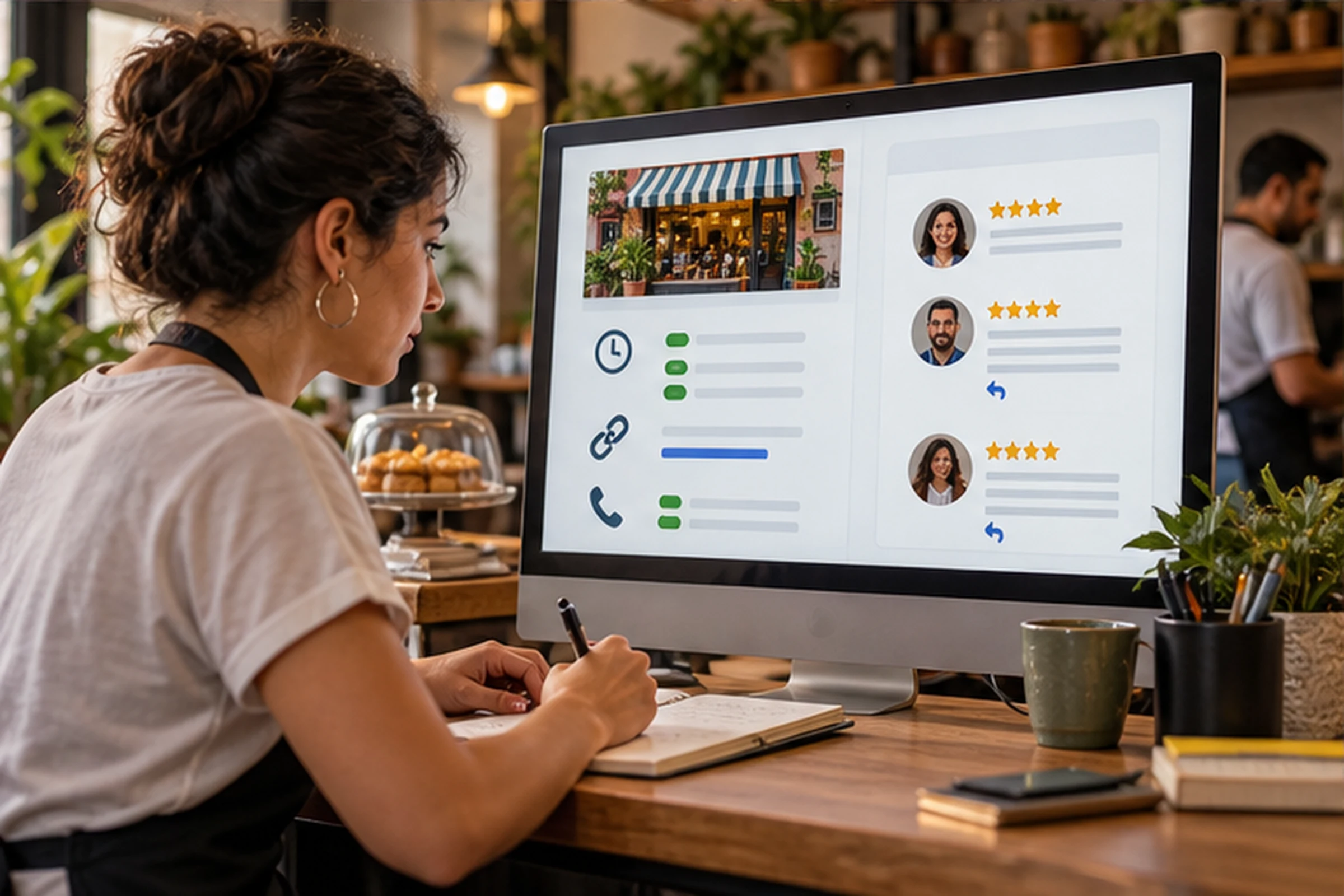
Solicit genuine reviews without undue incentives, biased selection, or fake accounts. Provide a link after a legitimate experience and respond respectfully. Do not share personal information or discuss sensitive data.
Analyze issues, not just averages. Reviews can reveal problems with scheduling, service, or product. Addressing the root cause is more beneficial than writing a defensive response.
Photos, posts, and questions
Use your own current photos of the facade, interior, staff, products, and entrance. Avoid generic stock photos that don't help identify the location. Respect people's rights and privacy.
The posts communicate new features, but do not replace the main information or website. Answer questions accurately and monitor contributions. Feature availability varies by market.
LocalBusiness Structured Data
Markup can describe business, address, hours, and other visible information. Choose the appropriate subtype and generate it from a consistent source. Don't fabricate valuations or locations. Follow the documentation. schema.
Validating code does not guarantee a specific result. It checks for canonical tags, indexability, and content consistency.
Authority and local links
Participate in associations, media outlets, vendors, events, and resources where a genuine relationship exists. A relevant local link can contribute to brand awareness and reputation. Avoid mass directories or sponsorships designed solely to manipulate.
Develop citable assets: research, guides, agendas, or useful data. Authority comes from presence and contribution, not from repeating anchor text with city names.
How to measure local SEO
Observe visibility by query and area, impressions, site clicks, calls, routes, and available actions, respecting definitions. On the site, measure valid forms, bookings, and sales. Link results to location or area without over-asserting attribution.
Rankings change depending on coordinates and context. A geolocated grid is an example. It saves location, date, device, and query. Compare with demand and operations.
Businesses with multiple locations
Each location needs an operational identity: eligible address, hours, contact person, website, team, and management. Maintain consistent names and categories when the operations are equivalent, according to policies, and document legitimate differences. Use groups and permissions to manage without sharing a single password.
Each location page should address arrival, parking or access, available services, service area, and contact information. It should link to a trackable location. Avoid content-free pages that simply provide an address.
Moving, closings and rebranding
Do not automatically create a new profile when you move. Follow the official procedure, update information, signage, website, and citations, and retain the entity where applicable. Use appropriate statuses for temporary or permanent closures.
On the site, redirect the old page to the most equivalent destination when it's retired. Inform customers and monitor external suggestions. A name change should reflect the real world, not an opportunity to add keywords.
Prevention and response to suspensions
Maintain operational documentation, signage, and location-related information. Review users and recent changes. If the profile is suspended, identify the applicable policy and correct it before requesting review; creating duplicates can complicate the situation.
Do not promise recovery or send sensitive documents to unauthorized third parties. Use official channels, register the case, and keep your website and other contact channels updated throughout the process.
Local competitive analysis
Compare categories, services, page quality, reviews, mentions, and coverage, without copying or falsely reporting. See which questions remain unanswered and what real differentiators the business can demonstrate.
The presence of a competitor from another area does not prove non-compliance. Distance and context vary. Only report objectively incorrect information through official channels and never organize attacks or negative reviews.
Experience and local conversion
The user might want to call, book, request directions, check inventory, or learn about accessibility. Prioritize these tasks on mobile and keep the information consistent between your profile and website. Test phone numbers, forms, messaging, and booking options.
Measure valid calls and completed visits, not just clicks. If demand increases but the phone doesn't answer or the hours are inconvenient, SEO amplifies a bad experience. Integrate operations into the plan.
Research and community content
Local questions arise from climate, regulations, neighborhoods, mobility, seasons, and events. Interview the team and customers to produce guides that a national website can't answer. Mention places only when they provide real guidance.
Don't publish other people's news to appear local. A calendar of closures, access recommendations, or your own studies can be more useful. Keep data and dates up to date to avoid sending people to outdated information.
Connect these resources from the location page and related categories. If a guide becomes outdated, update it or redirect to an equivalent; accumulating abandoned local pages reduces trust and makes it harder for users to find the current answer.
90-day plan
- Confirm eligibility and ownership.
- Audit profiles and duplicates.
- Normalizes master information.
- Correct category, schedule, URL, and phone number.
- Improve pages for real headquarters or areas.
- Implement ethical reviews.
- Publish your own photographs.
- Correct priority citations.
- Configure measurement and baseline.
- Review results and policies.
Common mistakes
- Add keywords to the name.
- Create virtual locations.
- Duplicate profiles.
- Use categories as a service list.
- Publish copied city pages.
- Buy reviews.
- Leaving outdated schedules.
- Measuring a ranking from a single point.
Local checklist
Confirm eligibility, real name, category, location, area, hours, contact information, website, ownership, reviews, photos, pages, citations, and measurement. Review policies before making large changes.
To build a strategy by city, you can check out the service of SEO o contact SEOMOS.
Sources consulted
Documentation consulted on September 10, 2026.
Frequently Asked Questions about Local SEO
What is local SEO?
It's about optimizing digital presence for searches related to a location and an eligible business.
Does paying improve organic local ranking?
Google states that you cannot request or pay for a better organic local ranking.
Can I use a virtual office?
Google's guidelines do not consider a virtual office without actual operation eligible according to its conditions.
Should I add the city to the name?
Only if it is part of the name actually used and can be proven; not as an added keyword.
How many categories are suitable?
Google recommends the fewest possible, specific and representative of the main activity.
How to measure positions?
It records query, coordinates, device, and date, and connects the sample with actions and income.