

CPC, or cost per click, indicates how much an advertiser pays, on average or individually, when someone clicks on an ad. It's calculated by dividing the cost by the number of clicks, but a low CPC doesn't necessarily mean the campaign is profitable. To determine if the cost is acceptable, it must be considered in relation to intent, conversion rate, margin, customer lifetime value, and measurement quality.
Two campaigns can have the same budget but very different costs per click. The first might attract hundreds of curious visitors; the second, fewer clicks from people close to buying. Comparing only CPC rewards volume, not necessarily results.
This guide explains what CPC is, how it's calculated, the difference between maximum, actual, and average CPC, what factors affect it, and how to estimate an economic threshold. The examples are hypothetical and intended to help understand decision-making, not to guarantee a universal cost.
What is CPC in digital advertising?
CPC means cost per click. In a pay-per-click (PPC) model, the advertiser pays when someone clicks on the ad. Google Ads also uses PPC., pay per click, as another name for this type of price.
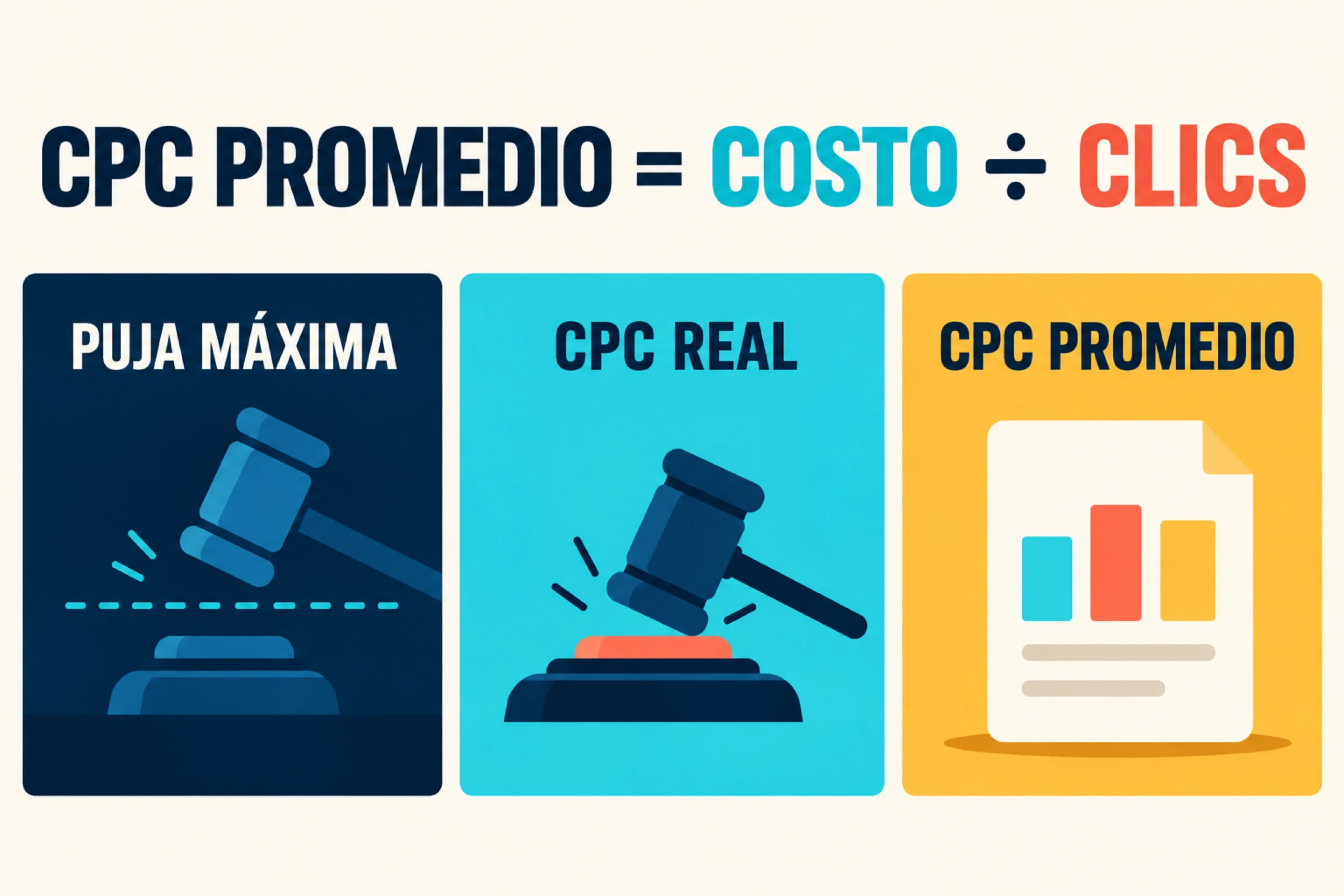
It is important to distinguish three concepts. maximum CPC It is the bid or limit you are normally willing to pay in a strategy that uses it. Actual CPC This is the final amount charged for a specific click. average CPC divide the accumulated cost by the number of clicks recorded.
Google explains that the actual CPC is usually lower than the maximum because the auction charges what's necessary to surpass Ad Rank thresholds and the next lowest competitor, although there are exceptions related to adjustments and configurations. The maximum bid is not a fixed rate.
How is CPC calculated?
The formula for average CPC is:
Average CPC = total cost of clicks ÷ number of clicksIf a campaign has a cost of 1,200,000 pesos and 800 valid clicks, the average CPC is 1,500 pesos. The calculation does not indicate how many clicks converted or how much value they generated.
The same logic applies to calculating the cost of an ad or keyword, provided that the cost and clicks correspond to the same period, currency, and reach. Do not mix data from one platform with clicks measured by another without explaining the differences: time zones, filters, redirects, and definitions can produce different figures.
An average can also mask variability. Some clicks may cost very little, while others far exceed the average. Segment by query, device, location, time, audience, and creative when there is sufficient volume to make a decision.
CPC, CPM, CTR, CPA and ROAS
| Metrics | Ask | Basic calculus |
|---|---|---|
| CPM | How much do a thousand prints cost? | Cost ÷ prints × 1,000 |
| CTR | What proportion of impressions generates clicks? | Clicks ÷ Impressions |
| CPC | How much does each click cost? | Cost ÷ clicks |
| CVR | What percentage of clicks converts? | Conversions ÷ clicks |
| CPA | How much does a conversion cost? | Cost ÷ conversions |
| ROAS | What attributed income returns the investment? | Attributed revenue ÷ advertising cost |
A high CTR can reduce the average CPC in certain scenarios by generating more clicks for a similar cost per impression, but it can be detrimental if the ad attracts the wrong people. A low CPA may still be insufficient if the measured conversion doesn't represent value.
To assess attributed revenue, consult the guide of ROAS. If the company has not yet defined indicators, review How to choose a KPI before optimizing isolated figures.
What factors influence CPC
Competition and demand. More eligible advertisers or valuable commercial intent can increase auction pressure. There is no fixed price table per keyword.
Bidding and strategy. Manual CPC allows you to set maximum bids; automated strategies adjust signals based on the available target. “Maximize clicks” aims to get as many clicks as possible within the budget and may have a maximum limit depending on the campaign type.
Quality and context. In search results, Google considers ad quality in Ad Rank. Relevance to the query, ad usefulness, and landing page experience all influence the ability to compete. Quality varies depending on the context.
Segmentation. Device, location, time of day, audience, and network all influence who enters the auction. A segment with a high CPC may have better conversion rates; don't exclude it without evaluating the results.
Creativity and format. An ad that communicates clearly can attract relevant clicks. On social media or display, the cost also depends on inventory, optimization goal, and audience response.
Season. Events, promotions, and changes in demand affect competition. Compare equivalent periods and track changes in budget, supply, and measurement.
Quality level is not the formula for CPC
Google defines Quality Score as a diagnostic tool, using a scale of 1 to 10 at the keyword level. Its components are expected CTR, ad relevance, and landing page experience. The documentation itself clarifies that the visible score is not a KPI nor a direct entry in the auction.
This matters because a simplified formula is often repeated that "a higher Quality Score always reduces the CPC." The auction uses real-time quality scores, but not the historical score displayed for diagnostic purposes. Use it to identify trends and review components, not as an isolated objective.
If the landing page experience appears below average, check the match between the query, ad, and page, the clarity of the offer, speed, accessibility, and ease of completing the action. landing page It shouldn't change just to meet a score: it should help the person decide.
How to estimate an economically acceptable maximum CPC
One initial way to relate the allowed value per conversion to the conversion rate is:
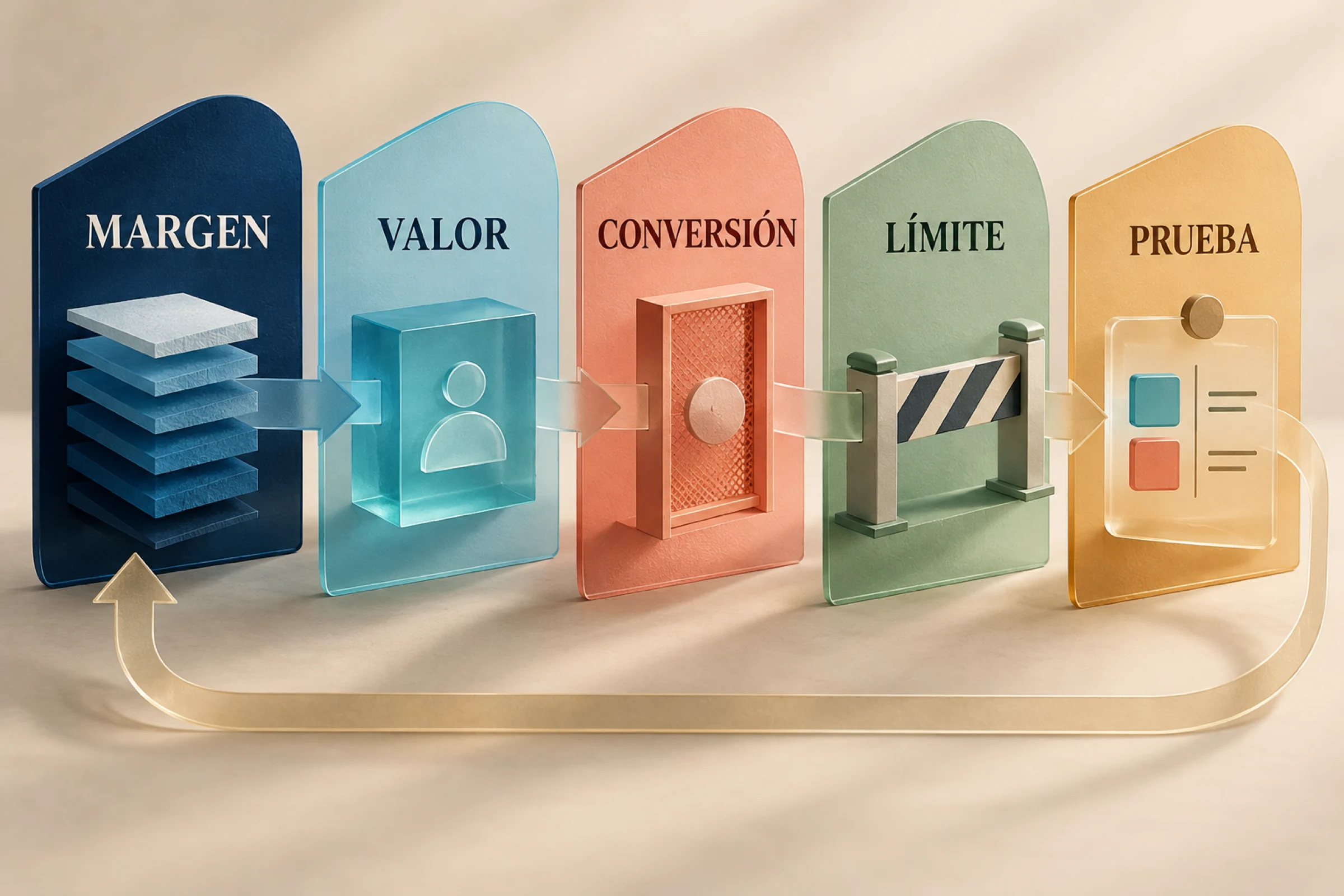
Approximate break-even CPC = allowable value per conversion × conversion rateSuppose a company can invest up to 120,000 pesos to acquire a sale and that 2 out of every 100 clicks convert. The approximate break-even CPC would be 2,400 pesos. Paying exactly that amount would leave the result at the defined limit, before considering discrepancies, returns, or other costs.
To operate with a safety margin, the target bid or CPC must be lower than the break-even point. If the allowable value is based on revenue rather than margin, the calculation may approve a campaign that loses money. This includes service costs, commissions, closing fees, and repeat purchase fees, where applicable.
In lead generation, form conversion does not equate to a customer. If 10% of leads become sales and the maximum cost per customer is 500,000 pesos, the maximum theoretical cost per lead would be 50,000. If the landing page converts 5% of clicks into leads, the break-even CPC would be 2,500. Each assumption should be based on a comparable cohort.
He customer acquisition cost It includes more than just advertising. A company can accept an advertising CPA and still exceed its target CAC due to marketing, tooling, and production costs.
When can a high CPC be acceptable?
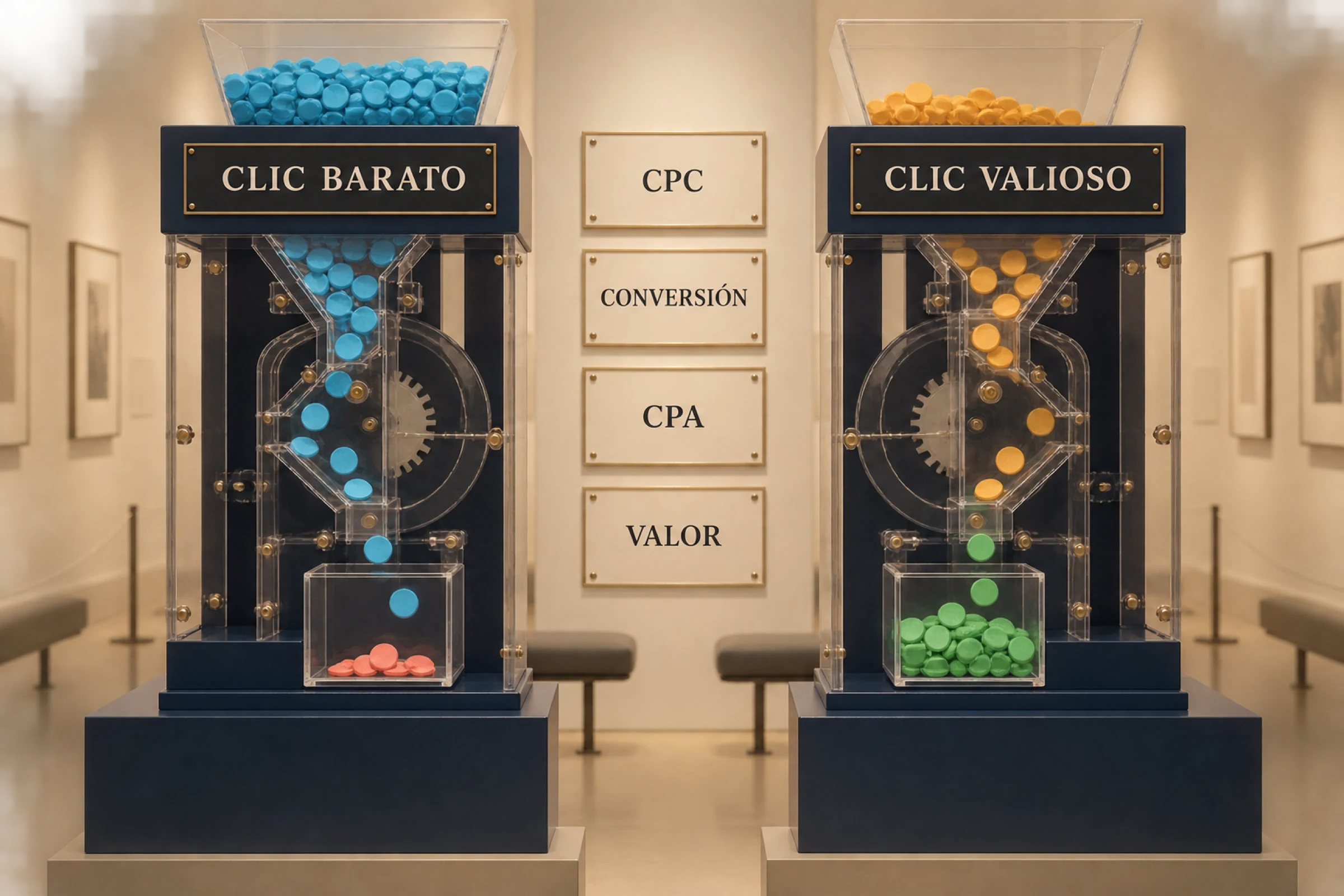
A higher CPC can make sense when the click comes from a customer more likely to make a purchase, the conversion rate is higher, the average order value or profit margin is greater, the customer is a repeat customer, or the segment has a better closing rate. The correct comparison is net value versus cost, not CPC versus an internet average.
For example, one keyword might cost 8,000 pesos and convert 8%, while another costs 2,000 and converts 0.5%. The first would have an approximate CPA of 100,000 pesos; the second, 400,000. The cheaper click would be four times more expensive per conversion.
A high CPC is not automatically justified by a large sale. If there is little data, variability is high. Use intervals, sufficient periods, and controlled experiments. Separate new customers from existing ones and primary conversions from micro-actions.
How to reduce CPC without compromising results
Refine intention and structure. Group queries that might receive the same message. Add negative keywords when you identify irrelevant searches. Don't chase volume that your offer can't handle.
Improve the ad-landing page link. The promise, content, and call to action must align. Google recommends choosing a landing page that is relevant to the ad and keywords.
Review segments. Compare cost and conversion rates by device, location, and time of day. Reduce or exclude only when there is evidence and the segment does not fulfill another objective.
Test creatives. A more targeted message can reduce clicks and improve quality. Evaluate CPA, value, and conversion rate, not just CTR or CPC.
Choose your strategy according to your goal. Maximizing clicks prioritizes traffic. If the real goal is conversion or value, and reliable measurement exists, review strategies geared toward that outcome within [the relevant department/system]. paid media.
Control the landing page. Speed, clarity, form, and trust all affect conversion. Improving your CVR increases the CPC you can afford, even if the auction price doesn't change.
Hypothetical example for comparing campaigns
Hypothetical example. Two campaigns promote the same service. Campaign A spends 2,000,000 pesos, gets 2,000 clicks and 20 sales. Its CPC is 1,000 and its CPA is 100,000. Campaign B spends 2,400,000 pesos, gets 800 clicks and 32 sales. Its CPC is 3,000 and its CPA is 75,000.
If each sale has a comparable initial margin, B is more efficient even though the click costs three times more. However, the final value, cancellations, and sales quality need to be examined. If B attracts small contracts and A attracts repeat customers, the interpretation may change.
The team segments by query and discovers that query A focuses on broad informational searches. They adjust negative search results and ads, but maintain an informational group with a limited budget because it supports future conversions. They document the objective of this group to avoid measuring it as if it were an immediate sale.
Common mistakes when interpreting CPC
Find an ideal universal CPC. It depends on the objective, margin, conversion, market, and measurement.
Confusing bidding with payment. Maximum CPC and actual CPC are distinct concepts.
Reduce bids without checking volume. A limit that is too low can restrict participation and clicks.
Optimize Quality Score as a KPI. It's a diagnostic tool; it reviews your business components and metrics.
Compare channels without context. A click on a search, video, or social network represents different experiences.
Ignore offline conversions. If sales are closed in CRM, importing them correctly can change the analysis.
Mixing currencies and periods. Normalize before comparing.
Conclude with small samples. A few conversions can move the average drastically.
Checklist for reviewing a campaign
- Cost and clicks use the same period, currency, and reach.
- Maximum, actual, and average CPC are not the same.
- The main conversion represents business value.
- The tracking of forms, calls, or sales was validated.
- CPC, CVR, CPA and overall value are calculated.
- The economic limit is based on margin and allowed cost.
- Queries, devices, and locations are reviewed by outcome.
- Quality Score is used as a diagnosis, not a goal.
- Changes are recorded and compared by equivalent cohorts.
If your CPC increases and it's unclear whether the problem is with the auction, targeting, landing page, or measurement, you can contact SEOMOS to evaluate the campaign with its full economic impact.
Sources consulted
Document consultation: September 10, 2026. Calculations are hypothetical examples. Bidding options vary by campaign type and may change.
- Google Ads: definition of cost per click.
- Google Ads: Actual CPC and Maximum CPC.
- Google Ads: Maximize Clicks Strategy.
- Google Ads: bidding strategies based on objective.
- Google Ads: Quality Score and its components.
- Google Ads: relationship between ad and landing page.
Frequently Asked Questions about CPC
What does CPC mean?
It stands for cost per click. It describes the amount charged for a click or the average cost divided by the number of clicks. In CPC bidding campaigns, there is also a maximum bid, which is different from the actual amount charged.
How is the average CPC calculated?
Divide the total cost per click by the number of clicks for the same period and reach. If you spend 500,000 pesos and receive 250 clicks, the average CPC is 2,000 pesos.
What is a good CPC?
It's the one that allows you to meet your financial objective with a profit margin. It depends on conversion, value, costs, competition, and quality. A low CPC can be bad if it attracts clicks that don't convert.
Are maximum CPC and actual CPC the same?
No. The maximum is the bid or limit set in compatible strategies. The actual CPC is the final amount charged per click and is often lower, although there are exceptions.
Does lowering the bid always reduce the CPC?
You can reduce costs, but also limit auctions, position, and volume. Evaluate how quality, conversion, and value change, not just the average paid.
What is the relationship between CPC and Quality Score?
Ad quality influences the auction, but the visible Quality Score is a diagnostic tool, not a direct input or a KPI. Review expected CTR, relevance, and landing page experience.