
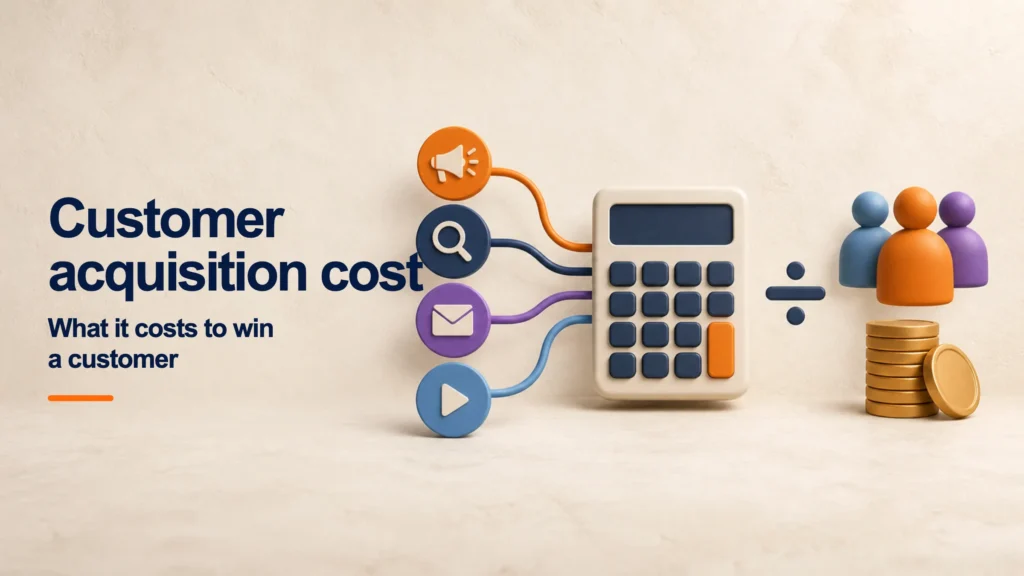
He customer acquisition cost, or CAC, This indicates how much a business invests, on average, to acquire a new customer. The formula is marketing and sales costs allocated to acquisition divided by the number of new customers acquired. A form, a conversation, or a purchase from a returning customer does not automatically equate to a new customer. The accuracy of the calculation depends on clearly defining the costs, the time period, and who is being counted.
What is customer acquisition cost?
Customer Acquisition Cost (CAC) allows you to link sales efforts to customer base growth. It helps evaluate whether a channel attracts suitable buyers, how much budget an acquisition goal requires, and how long the business needs to recoup that investment.
The definition includes more than advertising. HubSpot's CAC guide It incorporates marketing and sales costs, such as production, salaries, commissions, and tools, when involved in acquiring new customers. In practice, it's necessary to decide what proportion of shared resources is allocated to acquisition and document that decision.
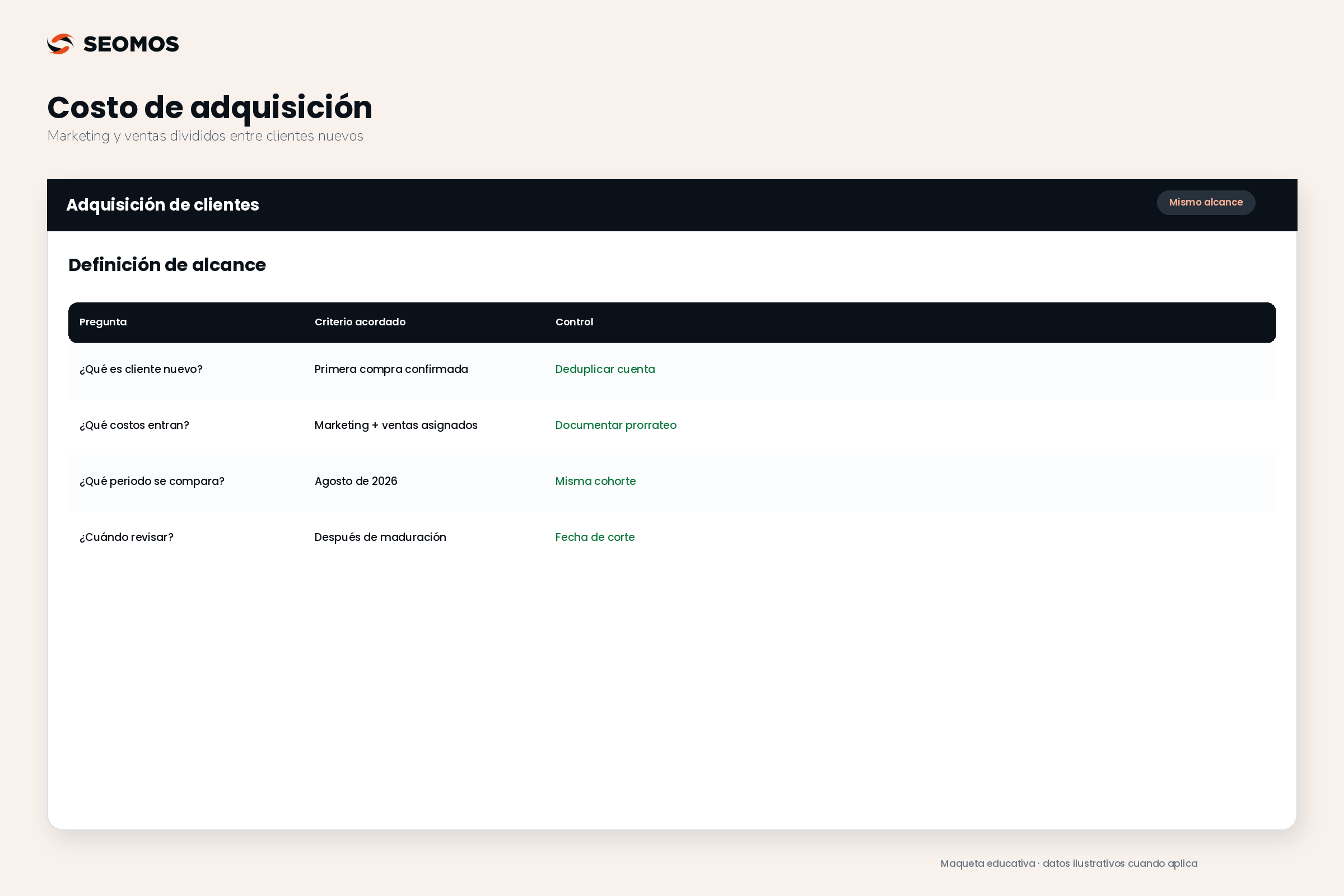
It's best to start with an operational question: what event turns someone into a customer? For a store, it might be the first paid and valid order; for a service, it's the accepted contract and the first payment according to a standardized policy. A free registration or an open opportunity shouldn't be counted as a purchase simply to lower the metric.
CAC formula and calculation conditions
CAC = acquisition costs included in the analysis ÷ corresponding number of new customers. The result is expressed in monetary terms per customer: for example, COP/customer. It is not a percentage.
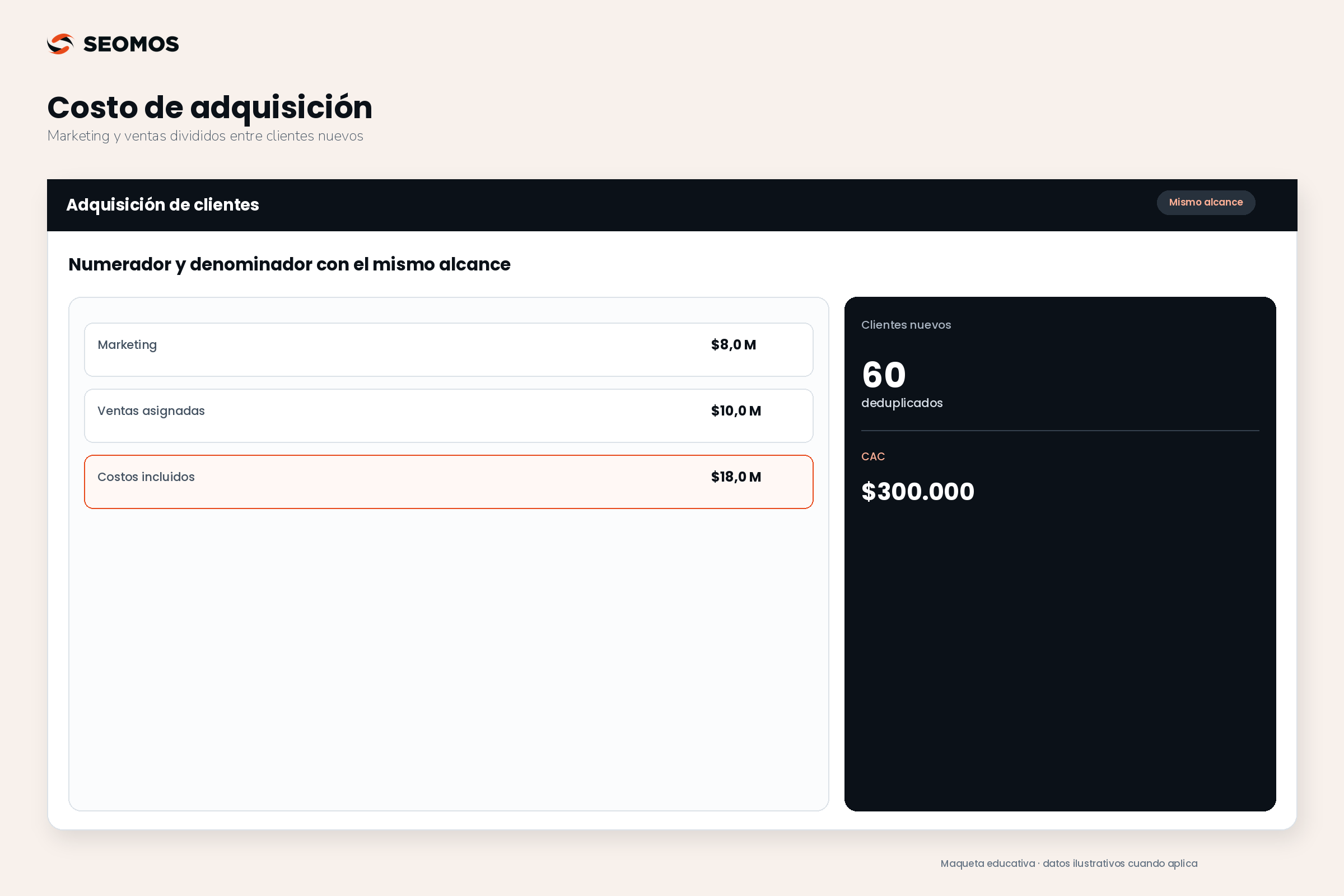
Hypothetical example. If a company spends COP 18,000,000 on acquisition and acquires 60 new customers within the defined scope, its CAC is 300,000 COP per customer. The division is simple; the trick is to avoid having one population in the numerator and another in the denominator.
It uses the same currency, a consistent tax policy, and a stable cost definition. It deduplicates repeat customers, distinguishes between previous buyers, and maintains the cancellation criteria. If there were no new customers, the CAC is not zero; it's an undefined split. It shows spending without acquisitions and analyzes whether the sales cycle is still open.
CAC and CPA: how to distinguish between customer and conversion
CPA measures the cost per action. Google Ads calculates the average CPA Based on the cost and number of conversions. That conversion can be a sale, a request, or any action that has been configured; that's why you need to read the event name before comparing it to the CAC.
| Indicator | What account | What question does it answer? |
|---|---|---|
| CPA form | Forms defined as conversions. | How much does it cost to acquire that stock? |
| Media cost per new customer | New customers attributable to advertisements. | How much advertising is invested per new buyer? |
| full CAC | New customers within the commercial reach. | How much does it cost to acquire them, including marketing and sales? |
| ROAS | Revenue attributable to advertising expenditure. | What revenue is generated per dollar spent on advertising? |
A low CPA can coexist with a high CAC if many leads don't fit the profile or don't make a purchase. And a purchase CPA can include orders from repeat customers. None of these figures are useless: they simply measure a different outcome. The guide to ROAS and its difference from ROI Develops the reading of income and profitability without confusing it with acquisition.
What costs to include in the CAC
Build an inventory of resources before looking for a number. Stripe's educational documentation on CAC It highlights both the sum of costs and the consistency over time and allocation of expenses that support acquisition and retention. The principle is useful beyond software, although each business model needs its own policy.
| Resource | What to allocate to acquisition | What to avoid |
|---|---|---|
| Advertising | Campaigns aimed at attracting new customers. | Mix all the retention without explaining the distribution. |
| Sales Team | Salaries and commissions related to acquiring and closing. | Forgetting the time of internal people or the founder. |
| Content and creativity | The production part that supports acquisition. | Accounting for the same cost across multiple channels. |
| Tools | Attributable portion of CRM, measurement and prospecting. | Assign each full license to all computers. |
| Agencies and suppliers | Fees and deliverables within the scope. | Confusing media budget with management fee. |
| Delivery and support | Separate them for customer contribution analysis. | Hiding them from economic analysis because they are not in CAC. |
Shared expenses can be categorized in various ways: based on logged hours, team time, or an agreed-upon distribution. Choose a method you can easily verify and review. If the distribution is approximate, report the uncertainty. This classification is for management purposes only; it does not replace accounting policies or imply that an expense should be capitalized for tax purposes.
Example of a Customer Acquisition Center (CAC) with advertising, equipment, and tools
Hypothetical example in COP, unrelated to clients or SEOMOS results. A company with a short buying cycle analyzes a closed month. It defines a new customer as a buyer identified with their first valid sale and uses the same criteria across all channels.
| Concept | Cost included |
|---|---|
| Advertising | 8,000,000 COP |
| Marketing and Sales Team | 6,000,000 COP |
| Content production | 2,000,000 COP |
| Assigned tools | 1,000,000 COP |
| Other procurement providers | 1,000,000 COP |
| Total | 18,000,000 COP |
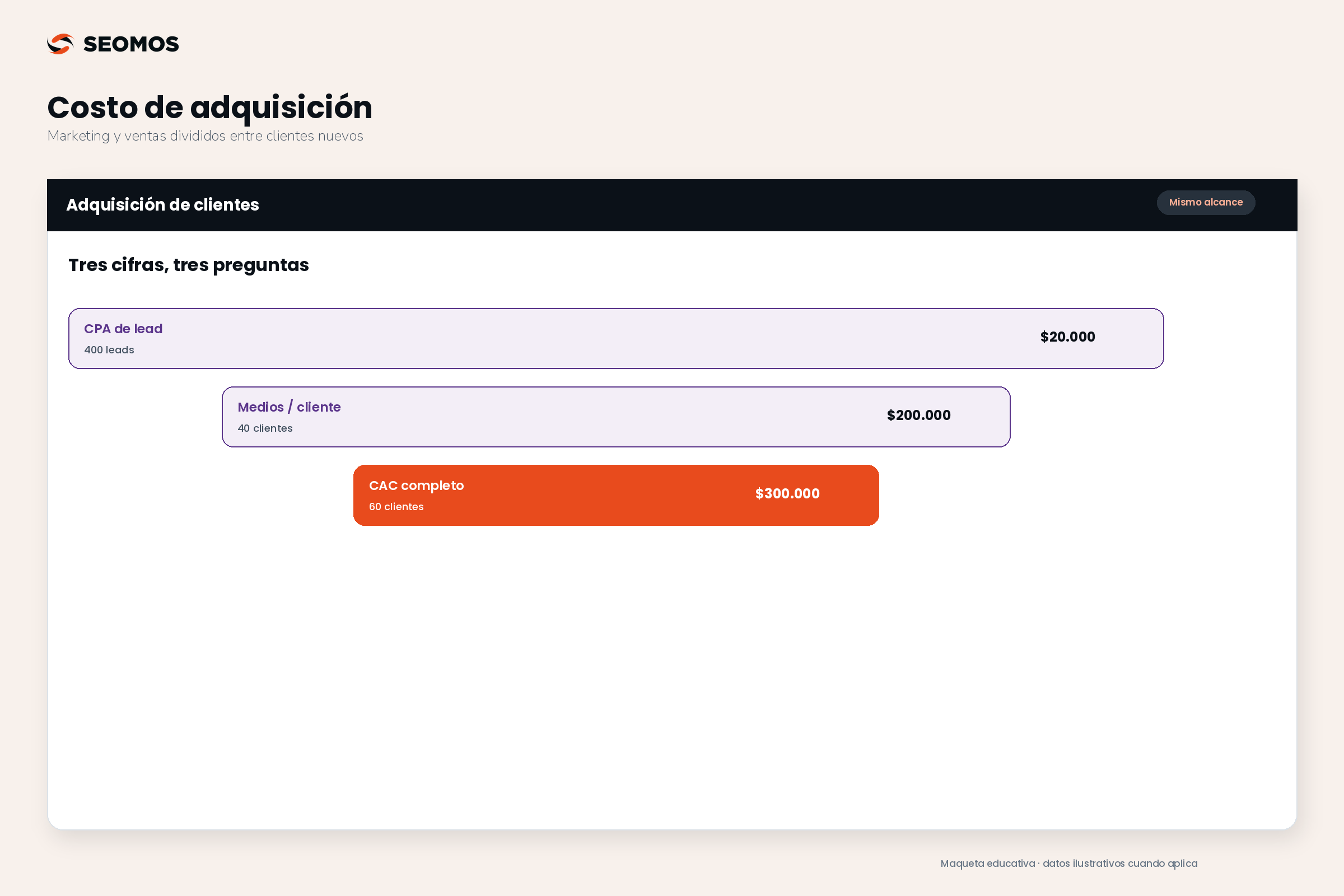
Sixty new clients join during the month. The full CAC is 18,000,000 ÷ 60 = 300,000 COP. In addition, the ads generate 400 valid leads, of which 40 are first-time buyers. The other 20 customers come from organic and referral channels.
The advertising CPA for a lead is 8,000,000 ÷ 400 = 20,000 COP. The media cost per new paid channel customer is 8,000,000 ÷ 40 = 200,000 COP. Neither of those two results replaces the full CAC of 300,000 COP.
If the report only showed "we acquired customers at 20,000 COP," it would be confusing leads and buyers. If it divided the 8,000,000 COP of advertising among the 60 customers across all channels, it would be combining different reach metrics and attributing customers to ads that the analysis didn't assign to them.
Full CAC, CAC by channel, and cost allocation
The overall CAC allows you to observe the overall economy. CAC by channel helps to investigate differences, but it requires allocating shared resources and assigning each customer using a consistent rule. You can't give 100% of a single customer's revenue to two channels and then add them up as separate acquisitions.
In the example, a documented allocation could distribute the 18,000,000 COP as follows: 12,000,000 for advertising and marketing support, 4,000,000 for organic reach, and 2,000,000 for referrals. If they generate 40, 15, and 5 clients, respectively, the Customer Acquisition Costs (CACs) would be approximately 300,000, 266,667, and 400,000 COP. The sum of costs and clients returns to the original total.
Don't conclude that referrals are the worst channel just because of those five clients. A small sample and a rough allocation can significantly change the ratio. Also, review the contribution, retention, and sales efforts of each group. "Organic" doesn't mean free either: content, optimization, and a team require resources.
How to manage long sales periods and cycles
Monthly Customer Acquisition Cost (CAC) is easy to track, but it can misalign investment with results. An August campaign might generate opportunities that close in October. Dividing all August spend by the number of customers closed that month would be a period indicator, not necessarily the cost of acquiring the cohort that began its journey in August.
It is useful to distinguish between two views. Per period: Costs and acquisitions recorded in the interval, useful for tracking trends if the process is relatively stable. By cohort: costs associated with a group of opportunities and clients that that group ends up generating, including the relevant commercial follow-up.
The cohort needs to mature. Indicate how many opportunities remain open, the data cutoff, and the subsequent costs incorporated. Do not compare a cohort with six months of follow-up and one with two weeks. Google Analytics cohort explorations They help to study groups by attributes and behavior, but a cohort of web users does not by itself replace the billing customer registry.
How to know if your CAC is sustainable
Customer Acquisition Cost (CAC) in isolation doesn't tell you how much you can invest. Compare it to the customer's contribution and the time it takes to recoup that contribution. A high-ticket customer might require a lot of service; a repeat customer might take months to generate the expected value.
If a hypothetical CAC of COP 300,000 is recovered with a stable contribution of COP 75,000 per month per customer, the simplified calculation yields four months. This result assumes the customer remains, pays, and maintains that margin for the full four months. If the amounts vary, use the actual accumulated contribution and observe when it exceeds the CAC.
The comparison with the CLV or customer lifetime value You must use compatible bases. A revenue projection without deducting costs is not equivalent to a contribution. Nor is there a CLV:CAC ratio that guarantees the health of all businesses: liquidity, longevity, risk, and overhead costs all matter.
How to reduce CAC without compromising quality
Start with the verifiable bottleneck. If you're receiving inquiries that are outside your target audience, review your segmentation and messaging. If there's interest but few sales, examine response times, clarity of the offer, and reasons for churn. If customers buy but cancel immediately, a seemingly inexpensive acquisition may be masking an underlying issue with expectations.
A landing page geared towards a specific intent It can help explain the offer and filter inquiries. It should be evaluated with relevant clients and complete cost data, not just forms. In the previous example, acquiring more leads without improving the 40 existing buyers would increase sales work and could raise the CAC.
Define an intervention, a population, and a review date. Process improvements should be noted along with their implementation costs. Coordinate measurement with paid media campaigns and the commercial registry; indiscriminately reducing investment can lower the absolute number of customers without improving efficiency.
Checklist for closing the CAC report
- The definition of a new customer is written and applied to all channels.
- Buyers are deduplicated and separated from leads and recurring customers.
- Shared costs have allocation criteria, responsible party, and review date.
- The period or cohort and its degree of maturity appear next to the result.
- The subtotals by channel reconcile with the total and do not duplicate acquisitions.
- The analysis includes contribution and recovery, in addition to the initial cost.
To turn this report into a management tool, define Which KPIs deserve to be monitored?, who is responsible for it and what action is triggered when it changes. The goal is to acquire the right customers sustainably, not to achieve the lowest number through cost exclusions.
Frequently asked questions about customer acquisition cost
Are CAC and cost per acquisition always the same?
Not necessarily. Some platforms call a configured conversion an acquisition, even if it's just a registration. Check which event is counted and what expenses are included. To talk about customer acquisition cost (CAC), the denominator should represent new customers and the numerator the acquisition costs for the defined reach.
Do the team salaries fall under the CAC?
The customer acquisition component must be considered within a holistic view. If an individual is involved in both acquisition and retention, they should use a documented allocation of responsibilities. Systematically excluding internal work can make one channel appear cheaper than one that uses external providers.
Should I count customers who have already purchased?
Not in the CAC of new customers. Repeat purchases and reactivations can be analyzed with proprietary indicators. Define a policy for returns, cancellations, and related accounts, and maintain the same criteria to avoid artificially altering the denominator from one month to the next.
What do I do if I have expenses but no new clients?
Record the expense and show the CAC as not calculable due to the absence of acquisitions. Do not enter zero. Check if the sales cycle is still open, if there are any follow-up errors, and if the contacts match the profile before concluding that the investment did not work.
Can I compare my CAC with that of another company?
Only with caution and equivalent definitions. Sector, channel, ticket size, included costs, country, and business cycle can significantly alter the figure. A comparison with your own historical data and mature cohorts is usually more actionable than adopting an external benchmark without understanding how it was calculated.
Is having a lower CAC always better?
No. You can attract cheap customers who buy little, abandon their accounts quickly, or require a lot of support. Evaluate their contribution, payback period, and how well they fit your offer. Customer Acquisition Cost (CAC) should support the business decision, not replace it.
Sources consulted
Consultation and editorial review: . The numerical exercises are hypothetical and use expressly defined management conventions.