

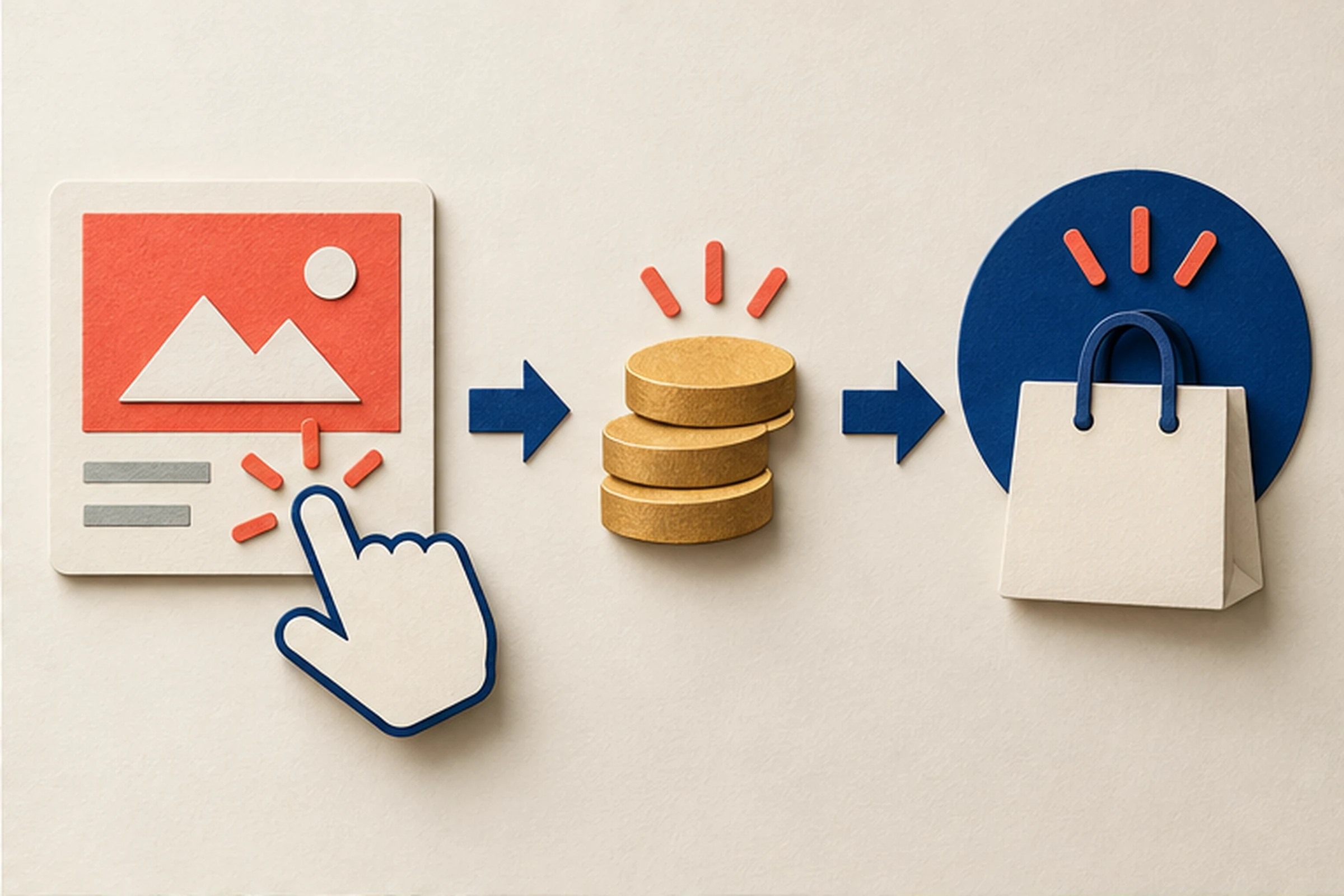
PPC means pay per click or pay-per-click. It's a digital advertising model where the advertiser pays when someone clicks on the ad. It's not a specific platform or channel: it can be used on search engines, social media, marketplaces, and other inventory. To properly evaluate it, the cost per click must be linked to the quality of the visit, the conversion rate, and the value generated.
The acronym seems simple, but it's often confused with CPC, SEM, search ads, and paid media. This mix leads to incorrect decisions: calling all digital investment "PPC," comparing campaigns with different billing models, or celebrating cheap clicks that don't produce any useful action.
This guide clarifies what PPC means, how payment is generated, where it's used, its advantages and limitations, and which metrics allow you to move from clicks to business insights. The examples are hypothetical and do not represent actual client results.
What does PPC mean in digital marketing?
PPC is the English abbreviation for pay per click. In Spanish, this translates to pay-per-click. The advertiser participates in an advertising system and pays for each billable click their ad receives, according to the platform's rules, bidding, and auction.
Google Ads explains that the price per click is also known as CPC. In practice, PPC usually refers to the model or advertising activity, while CPC identifies the cost of a click or its average. “We manage PPC” describes an operation; “the CPC was 2,400 pesos” describes a metric.
An ad can be shown many times without generating a per-click charge, although the platform may apply other rules for interactions, views, or invalid traffic. Paying for each click does not guarantee that the person will make a purchase, leave their contact information, or remain on the site.
PPC and CPC: relationship and difference
PPC answer “what model is used?” and CPC The answer is "how much did the click cost?" That's why they are closely related, but not identical.
The average CPC is calculated by dividing the cost attributed to clicks by the number of clicks. A campaign that invests 900,000 pesos and registers 600 clicks has an average CPC of 1,500 pesos. This average does not reflect the dispersion between auctions or the number of conversions.
It is also important to differentiate the maximum CPC bid of the Actual CPC. The first represents the limit or signal configured in compatible strategies. The second is the final cost per click. Google indicates that the actual cost is usually lower than the maximum bid because it's calculated using Ad Rank thresholds, eligible competition, context, and other auction factors; exceptions exist depending on bidding settings and tools.
The guide on What is CPC? It develops the formulas and shows how to estimate a limit from conversion rate and margin. This article focuses on the scope of the PPC model.
PPC, paid media, and SEM are not the same thing
| Concept | What describes | Examples |
|---|---|---|
| PPC | Click-based payment or management model. | Search or social advertising charged per click. |
| CPC | Individual or average amount per click. | Cost ÷ clicks. |
| Paid media | A discipline that manages paid media with various objectives and prices. | PPC, CPM, CPV, sponsorship, affiliation or direct agreements. |
| SEM | A term whose use varies; in the market it usually refers to paid advertising on search engines. | Search campaigns and, depending on the context, broader search engine marketing. |
Paid media It's the broadest operational umbrella: it includes strategy, audiences, creative, inventory buying, budget, experimentation, and measurement. A video campaign that optimizes views or a purchase per thousand impressions falls under paid media without necessarily being PPC.
SEM is more ambiguous. Historically, it can mean search engine marketing and include both organic and paid actions. In many teams and business proposals, it's used synonymously with search engine advertising. Before comparing services or reports, you should ask for a clear definition.
PPC isn't exclusively synonymous with Google Ads. The model can exist on social media, marketplaces, professional platforms, content networks, and retail ad systems. The settings and available inventory vary across platforms.
How a PPC campaign works
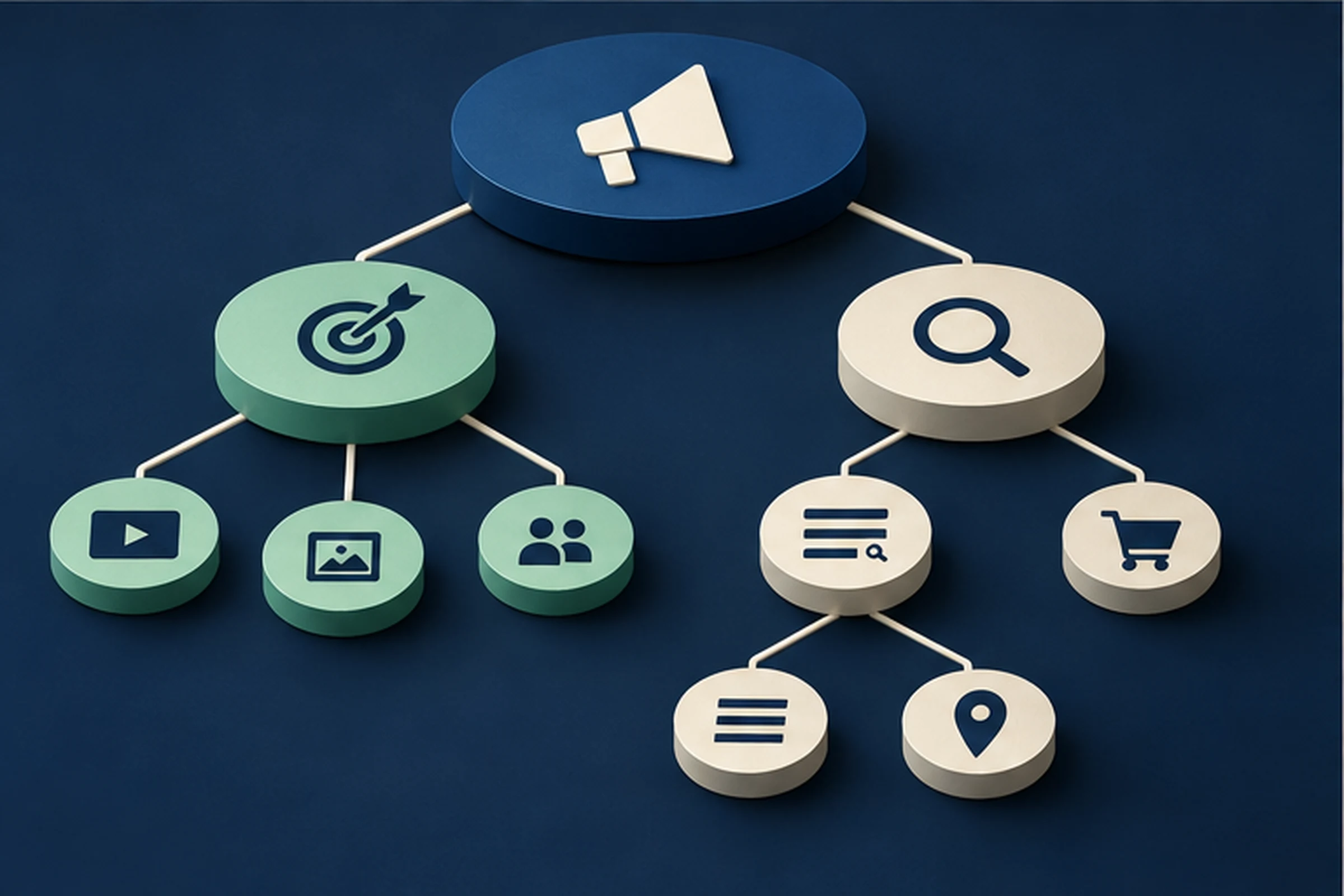
The details vary, but a campaign typically involves seven connected decisions.
- Aim. The valuable action is defined: sale, qualified lead, call, page visit or traffic for a specific investigation.
- Inventory and audience. You choose where the ad can appear and under what queries, locations, interests, signals, or contexts.
- Message. The creative approach presents a relevant proposal for that intention, without promising something that the landing page does not deliver.
- Bidding and budget. The account establishes how much you can invest and what objective guides the bidding strategy.
- Auction or selection. The platform evaluates eligibility, bidding, quality, context, and competition every time an opportunity arises.
- Click and log in. The person reaches the destination. A valid click results in payment under the PPC model.
- Outcome and learning. Events and business data allow you to relate traffic to conversions, value, and quality.
The auction doesn't always reward the highest bidder. In Google Search, Ad Rank considers bid, quality at the time of the auction, thresholds, competition, context, and the expected effect of the ad's resources. Other platforms use their own systems.
The bidding strategy must align with the objective. Google's documentation distinguishes between approaches for clicks, impressions, conversions, value, views, and interactions. Choosing "maximize clicks" for a campaign whose true success lies in revenue may increase visits without achieving the goal.
Where is pay-per-click used?
Search. Ads respond to queries. This is useful when there is explicit intent, but it needs structure, negatives, and consistent pages.
Social networks. Delivery can be based on audience, behavior, and creativity. Even if the report shows CPC, the system may be optimizing another action.
Marketplaces and retail media. Advertisements bring products closer to the point of purchase. Availability, profit margin, product specifications, and competition are all part of the outcome.
Display and content. Clicks can be purchased on websites, apps, or networks. The intent is usually different from a direct search and requires location and quality controls.
Professional platforms. Segmentation by job title or company can increase the CPC, but be reasonable if it connects with higher-value opportunities.
Two clicks with the same price are not equivalent. The context of exposure, prior intention, device, promise, and subsequent friction all modify their likelihood of generating value.
Advantages of PPC when it is well planned
Budgetary control. It is possible to set budgets, limits, and priorities, although the exact form depends on the platform and strategy.
Learning speed. A campaign can generate signals before an organic channel, provided it achieves sufficient traffic and measurement.
Segmentation and messaging. The team can link offers to specific queries, audiences, and stages.
Granular measurement. Costs, clicks, conversions, and value can be analyzed by campaign, group, ad, and other segments. Granularity does not correct a flawed implementation.
Experimentation. Variations in the proposal, landing page, and creative can be tested using predefined rules. Changing too many variables simultaneously eliminates the possibility of attributing the effect.
Complement to other channels. PPC can capture existing demand, test messages before an editorial investment, or reactivate audiences with valid consent.
Limits and risks that the click doesn't show
Traffic stops with the investment. PPC buys distribution; it does not, by itself, create a permanent organic asset.
A click can be irrelevant. Broad segmentation, ambiguous messages, or low-quality placements produce unintentional volume.
Attribution is not causation. A platform can attribute conversions within its windows, but that doesn't prove that all of them occurred solely because of the ad.
Automation depends on signals. If a conversion is duplicated, includes micro-actions, or is late, the algorithm learns with the wrong goal.
Privacy limits observation. Consent, browsers, and cross-device usage affect measurement. It is not appropriate to fill in gaps with fabricated precision.
The platform concentrates power. Formats, rules, competition, and costs can change. Maintaining your own data, useful pages, and a clear offering reduces dependence.
What metrics does a PPC campaign need?
The CPC is just the entry point. A useful board connects four levels:
- Delivery: impressions, reach, frequency, and eligible participation.
- Answer: clicks, CTR, CPC and quality sessions.
- Action: conversion rate, CPA, qualified leads, sales and abandonment.
- Worth: margin, attributable revenue, repetition, sales cycle and return.
PPC analysis: indicator, calculation and decision
| Indicator | Calculation | What to review |
|---|---|---|
| CTR | Clicks ÷ Impressions | If the query, the ad, and the offer all respond to the same intention, a high CTR does not demonstrate lead quality. |
| Average CPC | Spending ÷ clicks | If the cost per visit leaves room for conversion, compare it by intent, not just by campaign. |
| Conversion rate | Defined conversions ÷ eligible interactions | If the event measures a valid action and the landing page allows the user to complete it, then the same denominator should be used when comparing. |
| CPA or cost per result | Expenditure ÷ defined results | If the cost per qualified lead, opportunity, or sale fits within the business's economics, indicate which of those results you use. |
| ROAS | Attributable revenue ÷ advertising expenditure | If the recorded value is reliable and exceeds the margin threshold, it does not equate to profit. |
For PPC tracking, compare equivalent periods and segment by query, device, location, and landing page. If CPA worsens while CTR improves, review conversion quality before changing your bid. definition of Google Ads conversions It depends on the actions and attribution configured; leave those rules visible in the report.
For ecommerce, the ROAS It helps to link attributed revenue and investment, but it doesn't replace margin or total profitability. In demand generation, cost per lead should be accompanied by contact, opportunity, and close rates.
The landing page deserves its own metrics: speed, errors, form completion rate, and relevance to the ad. landing page Clara can increase conversion without changing the auction cost.
Hypothetical example of complete reading
Hypothetical example. A B2B company invests 3,000,000 pesos in search. It gets 1,000 clicks, so the average CPC is 3,000 pesos. It registers 50 forms, of which 20 meet the profile, 8 become opportunities, and 2 become clients.
The cost per form is 60,000 pesos; per qualified lead, 150,000; per opportunity, 375,000; and per customer, 1,500,000. If the team only reported CPC, they wouldn't be able to tell if the campaign is sustainable.
Upon segmentation, it's discovered that one group has a CPC of 4,800 pesos and generates the majority of leads, while another costs 1,600 pesos and produces forms outside the target market. The sensible decision isn't to shift everything to the cheapest click: first, the terms, ad, and form are corrected; then, the value per cohort is compared.

Process for creating or auditing a campaign
- Write the goal and primary conversion in one verifiable sentence.
- Calculate how much value or margin you can finance the acquisition.
- Define market, exclusions, language, device, and subsequent journey.
- Groups intentions that may receive the same ad and landing page.
- Configure events and verify that they are triggered once and with correct data.
- Choose your bidding approach based on your objective and the maturity of the signals.
- Publish specific, useful, and relevant messages.
- Establish a learning period and rules for intervention.
- Analyze queries, segments, conversions, and value; not just averages.
- Document changes to avoid attributing an improvement to multiple simultaneous actions.
If the business doesn't know its closing rate or margin, it's best to start with ranges and record the assumption. False accuracy is more dangerous than an explicit estimate.
Common mistakes in PPC advertising
Using PPC, SEM, and paid media as synonyms without context. Clarify which inventory and model each report includes.
Optimize for clicks when sales are needed. Volume does not compensate for a faulty signal.
Send everything to the same page. Different intentions require different responses.
Compare CPC between platforms as if the click were the same. Context and audience modify its value.
Count all actions as primary conversions. A visit or trip does not equal a lead.
Change budget, bid, and creativity at the same time. Therefore, there is no reliable explanation for the result.
Ignore offline sales. Without CRM feedback, optimization can favor easy but low-value leads.
Sources consulted
Document consultation: September 10, 2026. The available functions and strategies depend on the type of campaign and may change.
- Google Ads: Definition of CPC and PPC.
- Google Ads: Bidding strategies based on objective.
- Google Ads: actual cost per click and auction.
- Google Ads: Manual CPC Bidding.
Frequently Asked Questions about PPC
How do you do a PPC analysis?
Define useful conversions, validate their measurement, and relate spend, clicks, conversions, and value. Review CTR and CPC to understand incoming traffic; conversion rate and CPA to evaluate progress; and margin or ROAS to interpret the results. Segment queries and destinations before allocating budget: an average can mask campaigns that attract cheap clicks but lead outside the target audience.
What does PPC mean?
PPC stands for pay per click. It's an advertising model where the advertiser pays when someone clicks on the ad, according to the platform's terms and conditions.
Are PPC and CPC the same thing?
They are related. PPC usually refers to the advertising model or management; CPC is the individual or average cost of a click. The average CPC is calculated as cost divided by clicks.
Is PPC the same as SEM?
Not necessarily. PPC describes how billing works. SEM is usually used for search engine advertising, although its definition varies. There can be PPC outside of search engines and search engine campaigns optimized with another model.
Does PPC only exist in Google Ads?
No. It's used in search engines, social media, marketplaces, retail media, content networks, and other platforms. Each system has its own auction, segmentation, and measurement rules.
Does a low CPC indicate a good PPC campaign?
Not on its own. A cheap click can attract irrelevant traffic. It must be evaluated in conjunction with conversion rate, cost per acquisition, lead quality, margin, and value generated.
When is it advisable to hire PPC management?
When there is a clear offer, budget, capacity to meet demand, and a measurable action. If you need to review these elements, you can contact SEOMOS before scaling up investment.