

When a company starts working on its search engine optimization, sooner or later the question arises: "How much authority does my domain have?" The metric seems simple—a number on a scale—but misinterpreting it can lead to costly decisions: buying low-quality links, chasing metrics without context, or neglecting pages that actually generate business opportunities.
The domain authority It serves as a benchmark for comparing sites and observing the evolution of a link profile. However, its value lies in the analysis, not in the isolated number. A domain with a lower score can outperform another if it better responds to search intent, offers more useful content, has a solid technical structure, and builds trust signals relevant to its market.
In this guide you will learn what this metric means, how it is calculated, its relationship with Google, and what sustainable actions help improve a site's real authority.
What is domain authority?
Domain authority is a predictive metric developed by SEO software providers. The best-known one is Domain Authority Domain Authority (DA), created by Moz, uses a scale of 1 to 100 to estimate a domain's relative ability to compete in search results. Other platforms offer similar indicators with their own names and models.
It is important to separate two concepts. On the one hand there is the business metrics This is calculated by a tool using its own database. On the other hand, there is the authority that a brand builds in practice: reputation, demonstrable experience, relevant mentions, useful content, editorial links, and user satisfaction.
Google doesn't publish a "domain authority" score equivalent to DA. Its systems evaluate many page and site-level signals to decide which result best answers a search. Therefore, increasing a tool's metric shouldn't be the ultimate goal; it should be a consequence of improving the SEO ecosystem.
How is it calculated and why might it change?
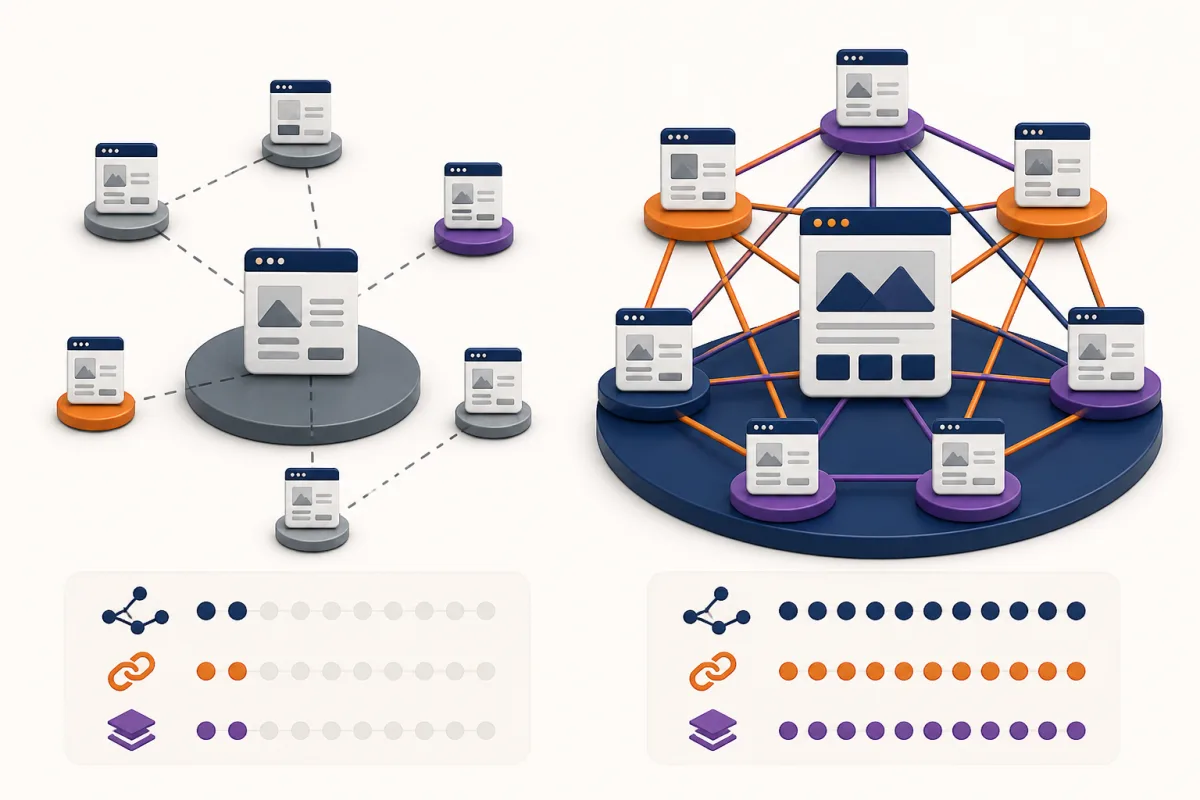
Each platform uses a different link index, variables, and models. Generally speaking, these metrics look at the estimated quantity and quality of domains linking to a site, the distribution of those links, and the relationships between pages within the web. Moz explains that its score is based on link data and a predictive model; you can check out their official authority guide.
The scale is usually logarithmic. This means that moving from a low to an intermediate score can be easier than gaining several points when the skill is already among the strongest in its category. It also means that there is no universal table to determine whether a score is "good" or "bad.".
Your score may drop even if you haven't made a mistake. The tool may expand its index, change its model, discover new competitor links, or reassess sites it already knew. That's why it's a good idea to analyze quarterly trends and compare them with truly equivalent domains.
Domain authority vs. page authority
Domain authority attempts to summarize the overall strength of a site. Page authority estimates the potential of a specific URL. This difference is crucial: a well-established domain doesn't automatically rank all new content, and an exceptional page can compete even within a smaller site.
A mature strategy incorporates both levels. The domain provides context, built-in trust, and discoverability; the page needs to fulfill a specific intent, receive useful internal links, and demonstrate sufficient depth.
Is domain authority a ranking factor?
Not as a third-party metric. Google doesn't use the figures you see on Moz, Semrush, or Ahrefs to rank its results. Those tools attempt to model part of a complex reality using their own databases.
That doesn't mean links and reputation are irrelevant. Google states in its SEO introduction guide Links help discover pages and can connect content with supporting resources. It also recommends creating useful, reliable information that is designed with people in mind.
The best interpretation is this: domain authority can function as a diagnostic indicator, But not as an isolated goal. If the score increases while qualified traffic, relevant queries, and conversions stagnate, the strategy needs review.
What factors strengthen the real authority of a site
1. Expert content that deserves to be cited
Content that naturally attracts links usually offers something hard to replace: original data, real-world examples, tools, templates, honest comparisons, clear definitions, or a more helpful explanation than what's readily available. Publishing for volume doesn't build authority if all the posts are the same.
Begin with an investigation of keywords Distinguish between informational questions, comparisons, and commercial searches. Then decide what experience, example, or evidence your company can contribute to each topic.
2. Editorial and relevant backlinks
A backlink is most effective when it comes from a related page, appears within an editorial context, and helps the reader expand their knowledge. Quantity alone does not compensate for a lack of relevance. A link from an industry association, a specialized publication, or a genuine partner can be more valuable than hundreds of automated profiles.
Furthermore, links must originate from legitimate activities: digital public relations, research, expert collaborations, linkable resources, and partnerships. Google considers creating links primarily to manipulate rankings to be spam, as explained in its spam policies.
3. Interlinking that distributes context and priority
The authority a site receives needs to flow to its strategic pages. A good interlinking y backlinking It connects complementary content, avoids orphaned pages, and shows which URLs are central within each topic.
Internal links should use descriptive and natural anchor text. “Learn about our SEO strategy” is more informative than “click here.” It's also advisable to link to the canonical URL, repair broken links, and reduce unnecessarily deep paths.
4. Technical basis and healthy indexing
There's no point in attracting mentions to pages that load poorly, redirect repeatedly, or can't be indexed. Check HTTP status, canonical tags, sitemap, architecture, mobile experience, performance, and rendering. The technical aspects don't replace editorial quality, but they allow search engines and users to access it.
5. Brand, authors and verifiable trust
Identifying the author, explaining the methodology, publishing clear corporate information, and maintaining up-to-date sources improves the reader's ability to evaluate the content. It also helps to showcase real-world experience: results with context, processes, responsible parties, and the limitations of the claims made.

How to improve domain authority step by step
- Define comparable competitors. Select businesses that compete for your audience and your inquiries, not global giants unrelated to your model.
- Audit links and content. Identify which pages attract mentions, which are orphaned, and where duplicate or superficial topics exist.
- Create linkable assets. Prioritize studies, calculators, definitive guides, glossaries, your own statistics, and resources that other publications want to cite.
- Strengthens thematic clusters. Connect a pillar page with specific content that answers related questions and leads to services.
- Get legitimate mentions. It handles public relations, alliances, expert participation, selective sector directories, and dissemination to relevant media.
- Recover existing opportunities. Fix broken backlinks, request updates for unlinked mentions, and redirect old resources when an equivalent replacement exists.
- Measure business results. It links new referring domains with impressions, clicks, positions, leads, and conversions.
The goal isn't to "increase DA" at any cost. The goal is to be a more useful, visible, and reliable source for people who can become customers.
Mistakes that hinder authority
- Buying link packages without checking origin, topic, or context.
- Publish dozens of nearly identical pieces of content to cover variations of a keyword.
- Compare the score with sites from completely different industries or sizes.
- Always use the same commercial anchor text artificially.
- Concentrate all backlinks on the homepage and abandon deeper pages.
- Confusing a tool price increase with real traffic or sales growth.
It's also a mistake to react to every unknown link. The internet naturally generates mentions of varying quality. Before disavowing domains, confirm whether there's a manipulative pattern or manual action and evaluate the case using technical criteria.
How to measure authority without relying on a single number
Build a dashboard with complementary indicators. Observe new and lost referring domains, backlinks to strategic pages, anchor text distribution, fastest-growing pages, untagged clicks, impressions, relevant queries, organic leads, and assisted conversions.
In Search Console you can track clicks, impressions, CTR, and average position. Google's own documentation explains the scope of these metrics. performance metrics. Cross-reference that data with GA4 and your CRM to understand what visibility produces business results.

How long does it take for authority to improve?
There is no fixed timeframe. A new site in a low-competition niche may see early signs within a few months; an established site in a demanding industry requires a continuous process. Speed depends on initial quality, the ability to produce valuable resources, the frequency of tracking, the competition, and the mentions received.
It's advisable to review progress monthly, but evaluate the strategic direction every three to six months. Quality backlinks, expert content, and brand recognition are cumulative assets, not quick fixes.
Frequently asked questions about domain authority
What is a good domain authority?
It's a competitive score compared to similar sites in your industry, country, and size. There's no single, universal score. Analyze the trend and relate it to rankings, relevant traffic, and conversions.
Is domain authority a Google metric?
No. Domain Authority belongs to Moz, and other tools create their own metrics. Google does not use these business scores directly to rank results.
Do backlinks always increase authority?
No. Their relevance, context, origin, and actual capacity to be valued all play a role. Manipulated, automated, or thematically unrelated links may not add value and, in severe cases, can pose risks.
Is it possible to improve authority without buying links?
Yes. It publishes original resources, develops digital public relations, retrieves mentions, collaborates with relevant organizations, and creates content that other sources will want to cite.
Why did my domain authority decrease?
This could be due to broken links, tool changes, index expansion, or competitor growth. Review the trend and organic results before assuming there's a problem.
Is it better to measure DA, DR or Authority Score?
No metric is absolute. Choose a stable benchmark for comparisons, understand its methodology, and supplement it with data from Search Console, analytics, conversions, and link quality.
How long does it take to increase authority?
It depends on your starting point and the competition. Evaluate progress every three to six months and maintain an ongoing strategy of content, relationships, and technical improvements.
Conclusion
Domain authority is useful when it guides you to ask better questions: which pages deserve more links, which competitors are building trust, which content is getting mentions, and where the internal architecture is wasting opportunities. It stops being useful when it becomes an obsession with increasing a number.
A solid strategy combines expert content, editorial links, internal linking, technical foundation, visible authorship, and business measurement. If you want to turn that diagnosis into a prioritized plan, learn about our service as SEO agency in Colombia.