

UTM parameters are tags added to a URL to identify the campaign, source, medium, and, when necessary, the piece that originated a visit. They allow you to organize acquisition data in tools like Google Analytics 4, but they don't correct misconfigured metrics or, on their own, demonstrate which channel caused a sale. Their value depends on a stable convention, proven links, and reports interpreted with the correct scope.
A link can work for the user and produce fragmented data. utm_source=linkedin, utm_source=LinkedIn y utm_source=ln They can end up in different rows even though they describe the same platform. When each person invents their own values, the report becomes a cleanup task.
This guide explains what UTM is, the purpose of each parameter, how to create a naming convention, and how to validate links before publishing them. It also clarifies common mistakes such as tagging internal links or mixing manual parameters with advertising auto-tagging without a documented solution.
What is UTM and how does it work?
UTM usually expands as Urchin Tracking Module, This name is inherited from the technology that preceded Google Analytics. These are parameter-value pairs added after the destination URL. The first parameter begins with a question mark, and subsequent parameters are separated by a hyphen. &.
https://www.ejemplo.com/guia/?utm_source=newsletter&utm_medium=email&utm_campaign=guia_analitica&utm_content=boton_principalWhen a person opens the link, the analytics tool can read the values and assign them to acquisition dimensions. Google explains that the source identifies the platform or location that referred the visit, the medium classifies the type of traffic, and the campaign represents the marketing initiative.
UTM parameters describe the link used. They do not, by themselves, store who clicked, trigger a conversion, or replace consent or settings. If the site fails to load the tag, redirects remove parameters, or the user blocks necessary technologies, information may be missing.
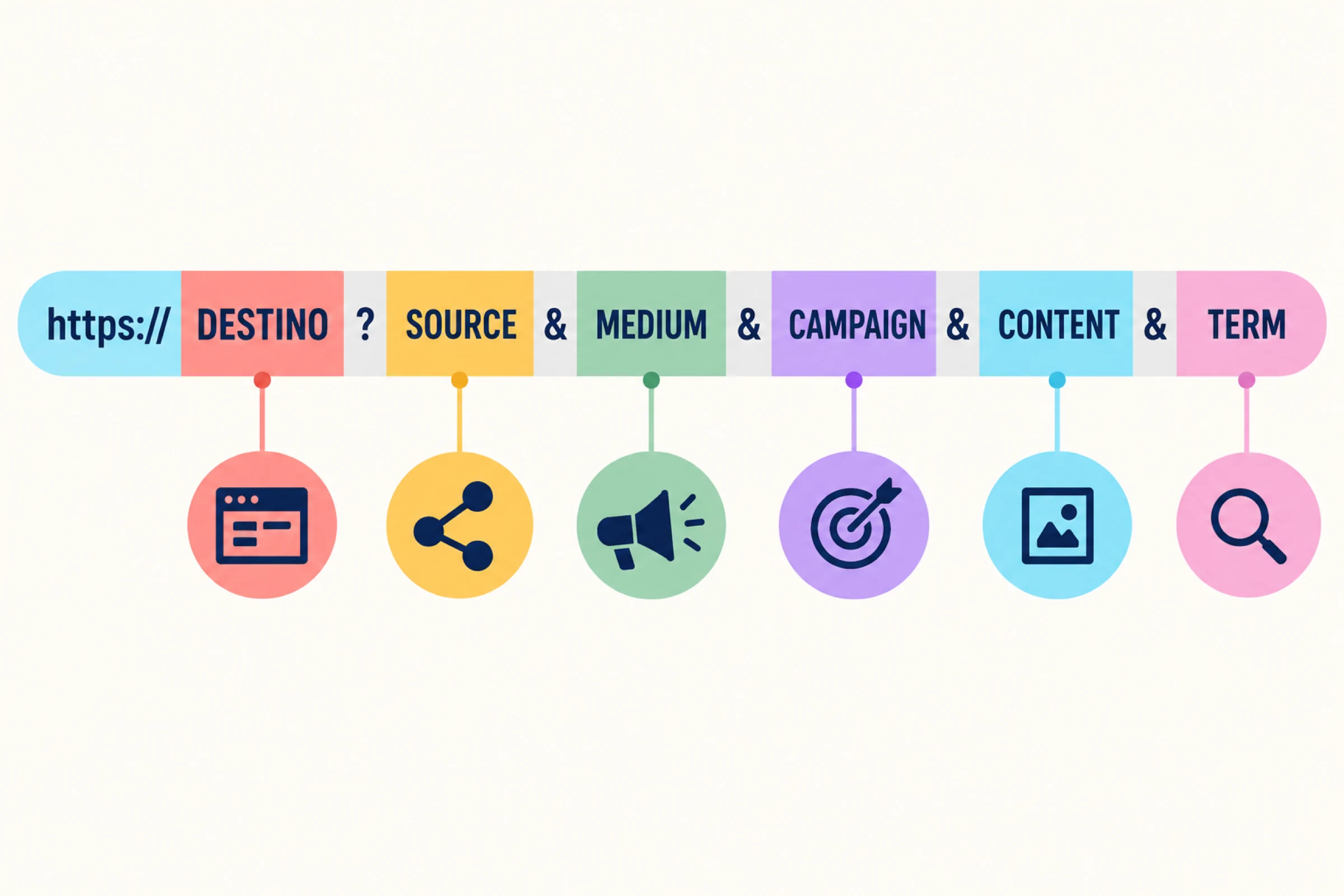
UTM parameters: source, medium, campaign, id, term and content
| Parameter | Describe | Example |
|---|---|---|
utm_source |
Platform, site or specific sender. | LinkedIn |
utm_medium |
Type of channel or mechanism. | paid_social, e-mail |
utm_campaign |
Initiative, launch or promotion. | CRM launch 2026 |
utm_id |
Stable campaign identifier. | crm_co_q3_04 |
utm_content |
Part, variant, or location. | video_demo |
utm_term |
Term or criterion, traditionally paid keyword. | sales software |
Source and medium are not interchangeable. The source answers “from where?” and the medium “through what type of traffic?”. For a LinkedIn campaign, a convention might use LinkedIn as a source and paid_social as a medium. In a newsletter, the source can identify the program and the medium remain as e-mail.
Campaign needs stability. If the name changes mid-period, the report is split. utm_id You can connect the link to a campaign table even if the descriptive name evolves.
Content difference pieces. Use it to compare creatives, buttons, or placements when that distinction leads to a decision. Don't turn the value into a long sentence with details that already exist on the platform.
Google also documents utm_source_platform, utm_creative_format y utm_marketing_tactic. Some dimensions are not currently listed as standard. Before adding them, check if the system will analyze them.
How to create a UTM nomenclature
A convention must be understandable, limited, and applicable to those who build links. Simply writing "use lowercase" isn't enough: you need a dictionary of allowed values, examples, and a person responsible for changes.
First, define the sources: Google, LinkedIn, Instagram, newsletter_clients. Then define transversal means: cpc, paid_social, e-mail, referral, QR code. Consult the current channel grouping rules; a creative asset may end up as “Unassigned” if it does not match expected criteria.
For campaigns, use a structure that outlasts the calendar and allows you to identify country, target, or product only when necessary:
utm_campaign=crm_co_demo_2026q3 utm_id=co-crm-2026q3-01Avoid sharing personal data, confidential budgets, and texts that shouldn't be circulated. The parameters appear in the browser's address bar, history, screenshots, and logs. Do not include names, emails, phone numbers, or sensitive information.
Google indicates that values are case-sensitive. Setting values to lowercase, using underscores, and using single characters reduces fragmentation. The exact rule may vary, but it should be applied consistently across the dashboard, platforms, and reports.
The UTM matrix as a source of truth
Centralize your links in a matrix. Each row can store destination URL, source, medium, campaign, ID, content, term, end link, responsible party, date, and status. Use controlled lists for source and medium, and generate the URL using a formula or automation.
Keeping fields separate allows you to correct rules, find duplicates, and audit active values. If a platform uses dynamic parameters, document the template and an example of the actual result.
Assign an identifier before creating dozens of links. When multiple teams collaborate, define who can add sources and media. A new value should address a need that existing ones don't cover.
Include the destination without UTM parameters and validate that it's canonical. If the slug changes, update the matrix and campaigns. A redirect can retain, remove, or duplicate parameters; test it in the actual journey.
How to create a URL with UTM step by step
1. Confirm the destination. Open the page, verify HTTPS, status 200, canonical version, and mobile experience. Do not label a URL that still redirects.
2. Select approved values. Use the dictionary for source and medium. Search for the campaign before creating another variant.
3. Add parameters. You can use a formula or the Campaign URL Builder recommended by Google. If the URL already contains a query, add a UTM parameter. &, not with a second question mark.
4. Encode characters. Spaces and reserved characters must be encoded. An underscore convention reduces ambiguity.
5. Open the final link. Check the destination and make sure it doesn't break in the channel where it will be published.
6. Validate the capture. Use a test property when possible and check real-time or DebugView. Then confirm that the session dimensions appear as expected.
7. Register and publish. Save the approved link in the matrix. Avoid editing it when pasting.

Examples of UTMs per channel
Newsletter:
https://www.ejemplo.com/reporte/?utm_source=newsletter_clientes&utm_medium=email&utm_campaign=reporte_q3&utm_content=boton_principalOrganic post on LinkedIn:
https://www.ejemplo.com/reporte/?utm_source=linkedin&utm_medium=organic_social&utm_campaign=reporte_q3&utm_content=carrusel_datosSocial advertisement:
https://www.ejemplo.com/reporte/?utm_source=instagram&utm_medium=paid_social&utm_campaign=reporte_q3&utm_content=video_15sQR code at event:
https://www.ejemplo.com/demo/?utm_source=evento_bogota&utm_medium=qr&utm_campaign=demo_crm_2026These are examples, not a universal vocabulary. If the organization already has a stable taxonomy, preserving it may be more important than copying another. Check that the media are grouped as the report expects.
UTM and advertising self-labeling
Google Ads can add automatic identifiers such as gclid When accounts and options are configured, auto-tagging adds dimension and reduces manual work. Don't replace it without reviewing the implications for attribution, conversion import, and reporting.
Google warns that combining manual details with advertising identifiers in certain contexts can lead to unexpected attribution. Its current documentation describes when UTM parameters take precedence or when data should be filled in. The decision should be tested in the actual integration, not based on Universal Analytics rules.
On other platforms, UTM is usually the common layer. Use dynamic parameters only if you know the values they produce. An unreplaced marker can literally appear in the report.
The measurement of paid media It requires events, costs, conversions, and attribution rules. UTM identifies the declared source of the click; it does not calculate profitability. For investment and return information, see the guide on ROAS.
Why you shouldn't use UTM in internal links
Adding UTM parameters to buttons, banners, or website navigation can alter campaign information. A person who arrived via organic search could end up being associated with an "internal campaign.".
For internal promotions, use specific ecommerce events, attributes, or IDs. Retain the source that brought the user to the site and record the internal interaction separately.
Also avoid UTM parameters in canonicals, navigation, breadcrumbs, and permanent editorial links. They generate variations that can be copied, shared, or tracked. A clean canonical parameter helps with consolidation, but it's best not to create unnecessary noise.
How to read UTM campaigns in Google Analytics 4
GA4 distinguishes dimensions with user, session, and event scope. “First user source” describes the source that initially acquired the user; “Session source” describes the origin of a session; event attribution dimensions distribute credit according to the selected model. Comparing figures without considering scope leads to contradictions.
The traffic acquisition report lets you review source, medium, and session campaign. The user report answers another question. Google points out that they shouldn't be directly compared as if they measure the same thing.
The traffic (direct) / (none) This indicates that Analytics lacks a clear source. It may include typed accesses, favorites, or untagged documents, as well as losses due to redirects, URL shorteners, or blocks. Not every "direct" link is brand recognition.
Build a board with dimensions of the same range and Defined KPIs. Separate quality from naming and performance. An "Unassigned" row may require correcting the medium; a low-revenue campaign may have impeccable labeling and a poor strategy.

UTM Audit and Quality Control
Periodically download data on source, medium, campaign, and sessions to identify capitalization, spaces, errors, empty values, and campaigns without IDs. Group variants and decide whether the correction will be prospective or will also transform the historical report.
Don't quietly rename an active campaign. Updating a few links splits the period. Record the date and replace all controllable items. Analytics will retain the originally captured value, even if an external dashboard normalizes it.
Test one sample per channel. For email, check that the platform doesn't misrepresent the link. For social media, open the actual ad. For QR codes, scan them on multiple devices. For documents, verify that the full hyperlink is embedded.
The marketing automation It can validate fields and build links, but it needs a dictionary, responsible party, and exception handling process.
Common errors with UTM parameters
Invent a medium for each campaign. It fragments channels and can send traffic to "Unassigned". Keep your vocabulary limited.
Mix up capital letters. The values distinguish capitalization. Use a standard and automatic validation.
Confusing source with campaign. utm_source=october_discount It prevents platform recognition. The initiative belongs to Campaign.
Label internal links. It can contaminate acquisition. It measures interactions with events.
Save personal information. The settings are visible. Never include emails, phone numbers, or names.
Do not test redirects. URL shorteners or server rules may delete the query.
Measuring without reach. First user, session and event answer different questions.
Confusing origin with causality. UTM provides a signal; the result depends on the model, window, and other contacts.
Checklist before launching a campaign
- The destination is final, certain, canonical, and responds correctly.
- Source and medium exist in the dictionary.
- Campaign and ID match the matrix.
- The values use lowercase letters and consistent separators.
- They do not include personal or sensitive data.
utm_contentdistinguishes an analyzable variant.- Dynamic parameters are replaced in a real test.
- The link survives redirects and the platform.
- GA4 receives the expected session dimensions.
- The team knows what report and scope it will use.
If the naming convention already produces duplicates or unassigned channels, a review can separate tagging and attribution. You can contact SEOMOS to evaluate the implementation.
Sources consulted
Document consultation: September 10, 2026. Names and links are hypothetical examples. Dimensions and integrations may change; please verify current documentation and configuration.
- Google Analytics: URL builders and campaign parameters.
- Google Analytics: traffic source dimensions.
- Google Analytics: Reach and Attribution of Dimensions.
- Google Analytics: Channel Groups.
- Google Analytics: user acquisition and traffic.
- Google Analytics: Direct Traffic.
Frequently Asked Questions about UTM
What does UTM mean?
UTM usually stands for Urchin Tracking Module. Today it's used for parameters added to a URL to describe the source, medium, campaign, and other characteristics of the link in analytics.
What are the three basic UTM parameters?
utm_source identifies platform, utm_medium classifies traffic and utm_campaign Name the initiative. Google recommends completing the relevant parameters and keeping values consistent.
Are UTMs case-sensitive?
Yeah. LinkedIn y LinkedIn They can appear separately. A lowercase convention, controlled lists, and a centralized generator reduce errors.
Should I use UTM in internal links?
No. They can alter the attribution and hide the original source. For banners, buttons, and internal promotions, use specific events or identifiers.
Where do I see the UTM campaigns in GA4?
Traffic acquisition allows you to review session dimensions. User acquisition uses first-user dimensions. Confirm reach before comparing figures.
Does a UTM link affect SEO?
Create a variant that can be shared or crawled, although a proper canonical tag usually consolidates it with the clean page. Avoid internal UTMs and unnecessary variants.