

YMYL means “Your Money or Your Life” It describes topics whose content could significantly affect the health, safety, financial stability, or well-being of individuals and society. In SEO, recognizing this risk helps determine what sources, reviews, and controls a page needs. It's not a penalty or a label that's triggered simply by mentioning money.
The useful question isn't just "Is my industry YMYL?". It's this: What might happen if someone follows an incorrect instruction on this page? A single website can publish an institutional history, a general explanation, and a recommendation that influences a sensitive decision. These should not undergo identical review.
This guide addresses the editorial and SEO management of such content. It does not offer medical, financial, or legal advice. Its objective is to help a marketing team recognize limitations, work with relevant professionals, and avoid the pressure to publish unsupported recommendations.
What is YMYL according to Google?
The Google quality assessment guidelines, section 2.3, They describe YMYL (Yield, Weight, and Liability) because of the significant harm that the topic or incorrect information can cause. The assessment allows for different levels: some issues are clearly sensitive, others are not, and there are intermediate situations. Not every commercial item requires the same consideration.
Google also notes that its systems place particular importance on trust in these matters. This does not mean EEAT It doesn't offer a scoring system or a list of changes that guarantees positions. The reference is the Official documentation on useful content.
For an editor, the difference lies in the consequence of the error. Making a mistake when describing a corporate color usually has a different impact than publishing an incorrect safety statement. The more serious the consequence and the less reversible the decision, the more important it is to check the content before publishing it.
Examples of YMYL content and cases that require context
The following table uses hypothetical situations for practice analysis. It is not an official Google ranking or a professional opinion. It evaluates the specific question, the audience, and the intended use; the blog category name alone is insufficient.
| Hypothetical content | What could possibly go wrong? | Proposed editorial approach |
|---|---|---|
| What to do in case of an emergency signal | An incorrect indication can delay care or compromise safety. | Expert review, competent sources, and extreme precision of scope. |
| How to interpret the terms of a debt | Omitting costs or conditions can distort an important economic decision. | Check product, country, date, assumptions and relevant review. |
| Requirements for a procedure that affects rights | An incorrect deadline or requirement can lead to a failed process. | Competent official source and clear limits of validity and jurisdiction. |
| Personal account of a difficult situation | The reader might confuse an individual experience with a general recommendation. | Identify the narrative and avoid extrapolating its results as expert advice. |
| History of a store logo | An error can cause misinformation, but the issue itself does not imply significant harm. | Normal factual review, without attributing sensitivity to it because it is a company. |
The format also matters. A carousel, a short video, or an answer within an FAQ might contain the site's most sensitive information. The review shouldn't be limited to the main article while publishing summaries that omit important conditions.
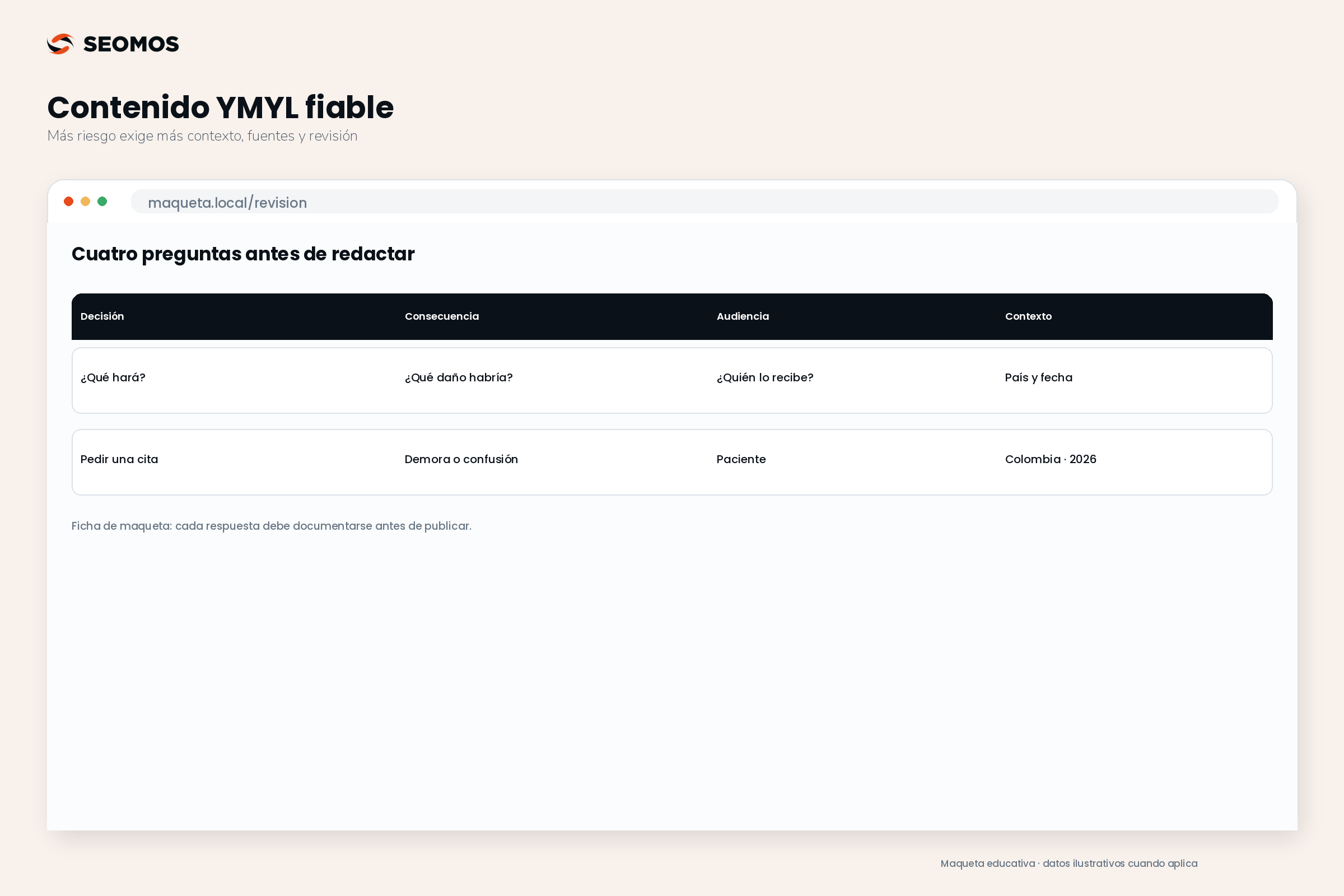
How to identify the editorial risk of a URL
Before you start writing, prepare a brief outline. You don't need to begin with a score; you need a revision decision that someone can justify. Record these four responses and keep the reasons if the team disagrees.
1. What decision could the reader make?
Understanding a concept, comparing options, completing a procedure, and taking action are all distinct. “What is insurance?” doesn't ask the exact same questions as recommending coverage for a specific situation. If the text jumps from a general explanation to a prescription, re-evaluate its scope.
2. What consequences would a mistake have?
Identify what information could change the decision: an omitted condition, an outdated date, an incorrect unit, or an exception presented as the rule. Also consider whether the action can be reversed. This discussion should focus on plausible scenarios, not on inventing a remote danger for any issue.
3. What is the context of the audience?
A reader may interpret a statement differently when they are worried, have little knowledge of the subject, or are looking for an urgent answer. Check if the title or call to action is unduly pushy. The clarity of limitations should also be maintained on mobile devices, without hiding them behind a button.
4. What conditions change the response
Country, jurisdiction, date, product version, and personal circumstances can affect the scope of the content. For an audience in Latin America and the United States, do not present a procedure from one country as valid throughout the region. If you cannot provide market-specific guidance, limit the page to general concepts and direct the user to the appropriate resource.
Based on these responses, assign an internal priority: high when an inaccuracy could cause significant harm; medium when the context needs clarification; and normal when routine editorial review is sufficient. These levels organize the team's work and are not labels that Google provides for your URLs.
Process for creating and reviewing YMYL content
Define the scope before searching for keywords
The brief should specify what question will be answered, for whom, and what will not be addressed. A high volume of questions doesn't justify venturing into an area the team can't handle. If a suitable specialist isn't yet available, you can keep the topic under investigation, narrow the scope, or prepare questions for a professional interview.
The keyword research It helps to understand the audience's language. Then you need to check if that intention can be addressed with responsible information and if another page already exists that fulfills the same need.
Assign authorship and review according to the statement
The writer can provide an explanation; the expert must validate what their specialty requires. It's not simply a matter of adding a well-known professional's signature at the end. There must be a genuine review of the relevant claims, with any issues addressed, before the expert's name appears as the reviewer.
Choose the person based on the subject matter and context, not just their position. One specialty doesn't automatically qualify you for another, and experience in one country doesn't guarantee a rule applicable in another. Keep a record outlining the scope of the review and avoid publishing private documents to demonstrate it.
Select sources that correspond to each statement
Use the responsible institution for official requirements and the relevant primary documentation for technical data. Identify the date, scope, population, or conditions of use when the interpretation changes. A prestigious source unrelated to the issue at hand does not resolve the verification.
In health, for example, MedlinePlus explains how to evaluate health information Reviewing who produces it, their sources, how it's updated, and their potential interests is a useful reference for designing editorial controls; it does not replace reviewing the specific clinical issue.
Write with limits that the reader can understand.
Separate facts, opinions, experiences, and hypothetical examples. Avoid turning the results of one case into a general promise. When a conclusion depends on assumptions, place them near the conclusion; a generic note at the end does not correct an absolute statement at the beginning.
Also review headlines, images, alt text, and excerpts. An illustration might suggest certainty where the text expresses uncertainty. A meta description promising a universal solution contradicts an article acknowledging multiple conditions.
Verify the complete draft and record the approval.
Provide the reviewer with the content exactly as the reader will see it: tables, FAQs, image captions, and calls to action included. Ask them to point out any incorrect statements, missing boundaries, and inappropriate sources. The review process doesn't end when you receive feedback; it ends when the feedback is incorporated and the revised version is checked.
If you use AI to organize or draft sections, the responsibility for verification does not disappear. Google's guide to content with generative AI Emphasize accuracy, quality, relevance, and context in your creation. Never present a model's answer as a primary source, nor invent a human review.
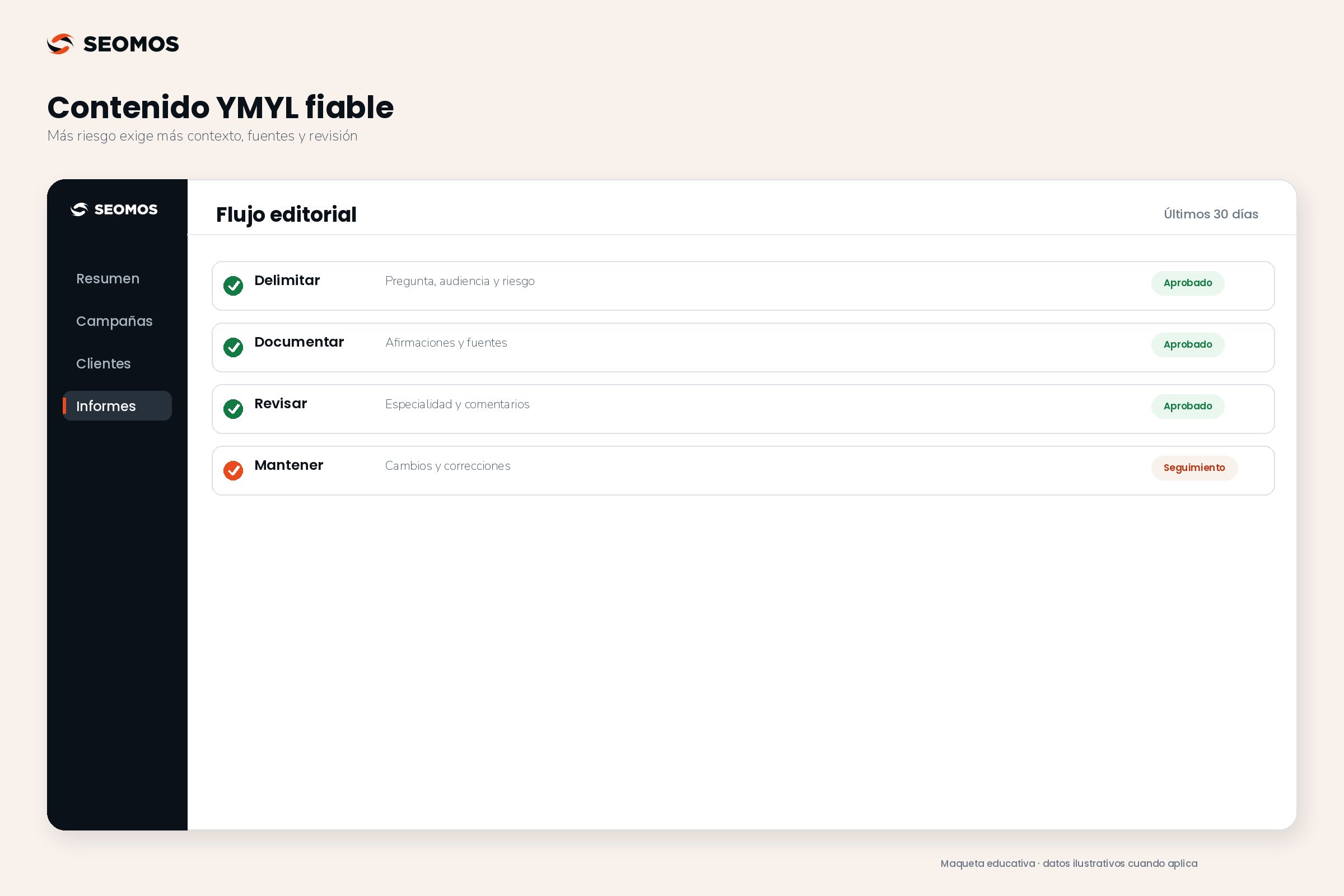
Example of editorial control for a site with sensitive content
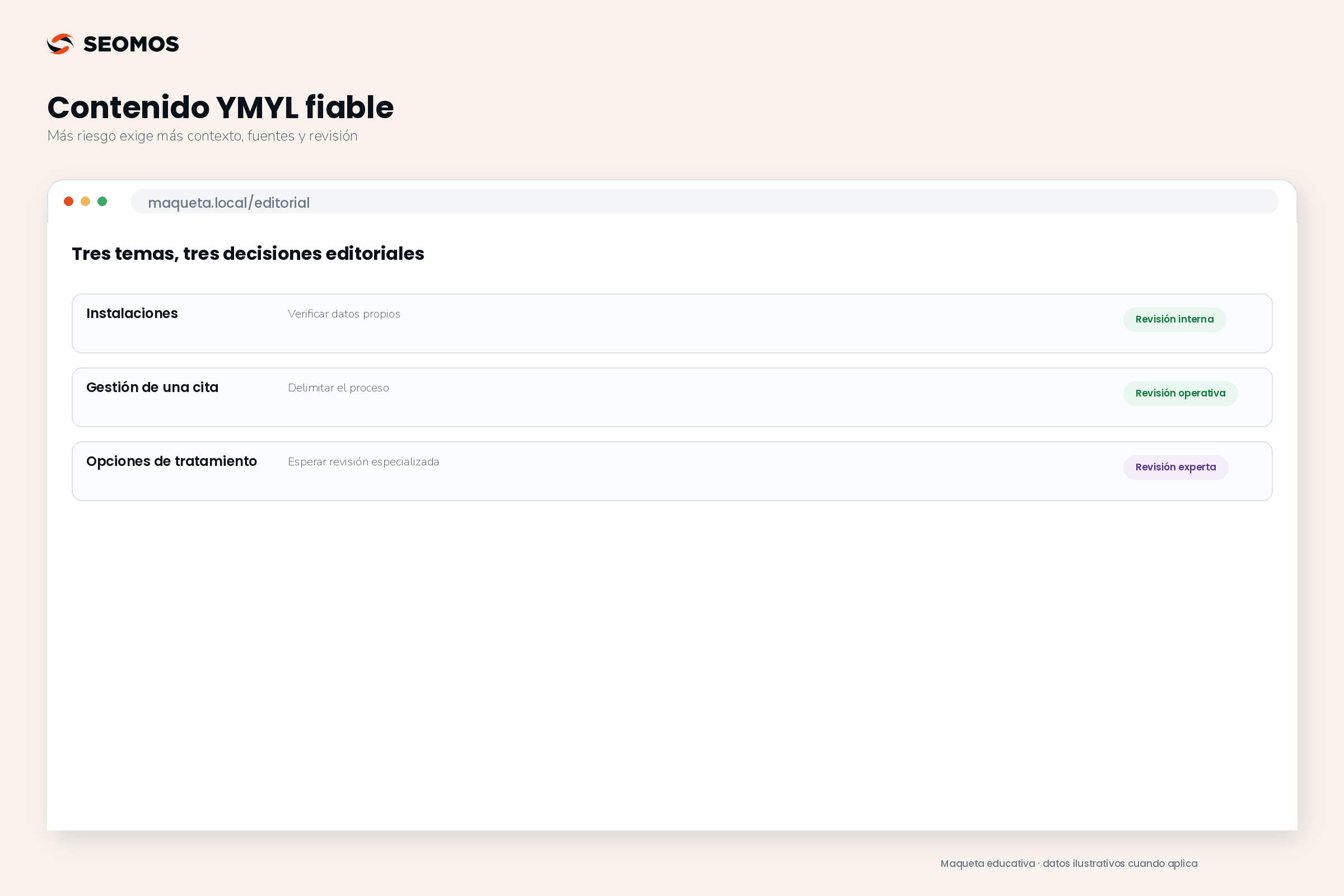
Hypothetical example. A healthcare center wants to publish three pieces: a presentation of its facilities, an explanation of how to prepare administratively for an appointment, and an article that would answer the question of which treatment to choose. The marketing team does not yet have a clinical review for the third piece.
The proposed editorial decision is to proceed with the submission after verifying our own data; review the administrative preparation with the person responsible for the process, without including clinical instructions; and keep the article on treatments in draft form until the appropriate professional is available. A medical signature is not added as a substitute for that review.
| Field | Example record |
|---|---|
| Ask | How care options are presented without recommending an individual choice. |
| Limit | Do not diagnose, prescribe, or determine which option is best for a specific person. |
| Editorial Manager | Organize sources, document version, and observations. |
| Review required | Relevant professional, still pending assignment and execution. |
| Closure test | Validation of claims and limits in the full version that would be published. |
| State | Draft: not ready for publication. |
This example doesn't evaluate a real clinic or propose a health-related course of action. It shows how an organization can continue producing useful content without forcing the publication of a piece for which it still lacks support.
Mistakes that a disclaimer does not correct
Writing "informative content" doesn't neutralize an incorrect recommendation. The most visible phrase still influences the reader. Correct the statement and its scope; don't rely on a distant note to resolve the contradiction.
Fabricated credentials, unsubstantiated sources, and unverified updated dates are also unacceptable. If a figure pertains to a different market or period, simply change the currency or country in the text to make it appear the same. You need applicable evidence or an explanation that the example is purely illustrative.
Another mistake is copying a guide for each city or country without changing its core principles. Besides repeating content, this can lead to presenting different rules as if they were equivalent. Maintain a central explanation where valid and develop a local version only if there is a specific need and has been reviewed.
How to maintain content and check for improvements
Assign each URL a responsible party and define events that trigger a review: a change in the source, a reported error, a new product condition, or a modification to the described service. Supplement these alerts with periodic reviews based on risk. There is no universal interval that makes any article reliable.
Maintain a simple history of what changed and why. If you spot a critical error, prioritize fixing it and review where it was reused: excerpts, social media posts, newsletters, or downloadable documents. To design consistent reuse, the content of SEO for social media It helps to connect the formats with the main piece.
Measure controls and outcomes separately: pending reviews, unsupported claims, and bug fixes versus visits, inquiries, and contacts. No traffic growth makes a claim true. If you need a site evaluation, our service SEO It can serve as a starting point for discussing scope, without replacing specialized content validation.
Frequently Asked Questions about YMYL
Is YMYL a Google penalty?
No. It describes issues with potentially significant consequences for individuals or society. A manual action is a separate procedure related to policy violations. If you suspect one exists, check the relevant Search Console report instead of attributing any downtime to YMYL.
Is all content about money YMYL?
Not just mentioning it. Evaluate whether the information could significantly affect financial stability or a sensitive decision. Explaining a store promotion and guiding a borrowing decision do not pose the same risk or require identical scrutiny.
Can a personal testimony be published in a YMYL thread?
It can offer valuable insight when presented as a personal experience, is reliable, and doesn't become unsubstantiated expert advice. Don't fabricate testimonials or generalize from one case as if it predicts the outcome for others.
Is it enough for a professional to sign the article?
No. The signature must correspond to actual and relevant involvement. The content needs review of claims that require your knowledge, appropriate sources, and clear boundaries. Do not show approval or review before it has been completed.
Do I need to create a different URL for each country?
Only create a guide when there is a need for substantially different search and content that you can maintain and review. If requirements, conditions, or authorities change, narrow down the market. If the explanation is common, one well-defined guide can be more useful than several copies with country names.
How can I tell if a drop in traffic is related to content quality?
First, review which pages and queries changed, the indexing, technical issues, manual actions, and demand. Then, compare the content and its sources. A temporal coincidence does not prove a single cause, nor does it allow for diagnosing a supposed YMYL penalty.
Sources consulted
Document consultation: August 31, 2026. The worksheet, priorities and examples are editorial proposals, not an official classification or a professional review of particular cases.
- Google: Search Quality Evaluator Guidelines, version of September 11, 2025, sections 2.3 and 3.4.1.
- Google Search Central: Useful content, trust, and YMYL topics.
- MedlinePlus: Health Information Assessment.
- Google Search Central: Content guidance with generative AI.
- Google Search Console: Manual Actions Report.
- Google Search Console: How to investigate a drop in traffic.